Friday, October 15, 2010

Getting Stoned--Paleozoically

I knew getting photographs in a place like this, so large and so dark, would be problematic. I couldn't have predicted, having never been somewhere like this, that the air would be so littered with either mist or what I suspect was marble dust, or both. In fact, when we went back to the bus, I was convinced I could taste marble dust in my mouth, but that was probably just my overactive imagination. With the flash, I could immediately see I was getting all these ghostly orbs. I don't have a terribly big or expensive camera. I didn't want one; I was going for utmost portability. But I had to be very careful with the flash so I could get the pictures I wanted.

Anyway, you can sort of see there what they're doing, pulling on the huge block of marble with the bucket of the bucket loader until it tips over.

Here's Robertson (in the hard hat, obviously) explaining what was going on behind him, which was unfortunately too dark for me to get a good shot of it. They were marking a line on a block of marble where it would be cut in half. We were then asked to proceed into the main cavern.

If I weren't a classy type of guy, I might mention that some of the ladies were batting their eyelashes an awful lot while talking to the ruggedly handsome Mr. Robertson. But I am very classy, of course, so I won't. I wouldn't want to embarrass them.
We hiked down into that gorge and then back up again into the main part of this section, which was visually unreal but I'll have to say not as large as I expected.
One woman remarked to me how amazing it was to be completely encased in a marble "room"--walls, ceiling, and floor. I said it was a bit like being in a mausoleum, she said it was much brighter, which it was.


Those grooves in the wall are obviously where they cut the marble blocks to dislodge them. Each block weighs around 60,000 pounds.
Here's one of the diamond saws at work. I'm sure it's mostly automated, but basically they just turn it on and let it run until the cut is completed.
I was kind of surprised at how slowly the blade revolves. I'd estimate no faster than about fifty or sixty revolutions per minute. Evidently cutting more slowly is easier on the saw blade, especially if it encounters a vein of harder stone like quartz.
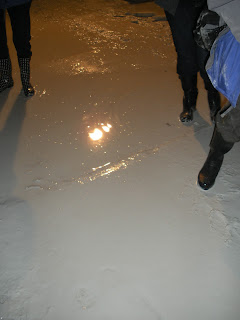
I was also struck while walking around here at how goopy everything was. The ground is entirely covered in what I called "marble soup." It's sort of like a highly pureed vichyssoise. I asked Robertson if it's always like that, or if it was because of the rain outside. He said it always is, because everything they do requires water, and a lot of it. As with most harder materials like this, all the cutting of the marble needs to be wet for lubrication and to relieve the heat. My boots and the bottom of my pants were coated in marble soup. I did notice one of my fellow visitors had tucked his pants into his socks, which I thought was very smart. By the time I saw that, it was already too late for my unfortunate pants. I'd worn an old pair anyway, so it didn't matter much.

Next we got to see them removing one of the cut blocks of marble from the wall face. They also have a massive front-end loader with a forklift rig, but first they sort of lift it up from the bottom and pull it out further to the edge.
Then they pull it out further so it drops into the bucket.
And off it goes. I overheard someone ask how often they drop one onto the floor and the answer was "never."

Here's the corner with the block carted off. That's Jeff examining the results. I got to speak with Jeff later in the day. He's an architect working for a small interiors firm in New York, but was first in Chicago for many years. He said he worked for a gigantic firm there, and I suspected he might be referring to Skidmore, Owings & Merrill, so I asked him. Turns out I was right. I was very impressed by that, I'll have to say. He was like "you know them?" Uh, YEAH. I almost started gushing about Gordon Bunshaft, but decided to restrain myself.
Then they brought in the forklift loader to take out the next block. It was sort of funny when this giant machine approached. Robertson was waving his arms and yelling "get out of the way!" But everyone kind of stood there and stared at it like deer caught in headlights. It really was mesmerizing to watch, though.
Here's Luca Mannolini measuring the block and writing "Artistic Tile" on it. That was probably just a photo op gesture, because Artistic Tile offers the Imperial Danby that's harvested from the other side of the quarry. Still, it was amusing. I asked Levinson if he was going to take it back with us on the bus. I was struck by how smooth the cut was; I would have expected it to be much more rough before it's taken to be finished.

I grabbed a little chunk of marble off the floor as a souvenir. I asked Mr. Mannolini if that was alright. He said the rule is that anything you can carry away with your hands is free. That probably isn't an official rule. I suppose they probably don't want sculptors knowing that, but then, I assume they don't let just anyone come in and wander around the quarry looking for scraps, either. Later I discovered other guests had taken much larger pieces than I had, but my apartment doesn't really need any more stuff in it, so this one will do just fine as a memento.

Part 3.


All text and images ©2010, Ryan Witte.

Monday, October 11, 2010

Getting Stoned--Proterozoically

When I woke up the morning of Thursday, September 30th at the ungodly hour of 5:30AM, I discovered it was not just raining, but a torrential downpour. I was not going to let that stop me from seeing the Danby Quarry in Vermont, however, the largest underground quarry in the world. I dragged myself out of bed.

All photos ©2010, Ryan Witte.
The trip was organized by the lovely folks at Artistic Tile. When I found out how many people the bus would hold (about sixty-five), discovered how many of Artistic Tile's own people were along, and that the remaining seats were divided up amongst a select group of architects, interior designers, and other journalists, I felt extremely flattered to have been invited. Second to witnessing the move of the Lieb House, this was probably one of the most extraordinary things I've ever seen.

As I made my way to the train in the dim dawn light, earlier than I'd ever done so at least in my current neighborhood, I speculated about the other people beginning their commute. I decided they must be elementary school teachers or people for whom it was time to make the donuts. The streets were fairly barren although, surprisingly, the train was not all that empty.

When I got to their showroom on West Twenty-First Street, I signed in and was informed they had coffee. I was grateful since I'd only had time for a single cup before leaving the house, not nearly enough fuel for that early hour. This was only the beginning of what was to be a virtual cornucopia of amenities they provided on the trip. While pouring my second cup, I got to meet John DeSoto, who I later learned is an architect as well as a painter. I looked around at some of their gorgeous bathroom displays and within another ten minutes we were loaded up onto the bus on our way to New Jersey.

Our first stop was the Artistic Tile showroom in Paramus. We had more people to pick up there, including the president of the company, Josh Levinson, and his daughters, who had gotten off of school to come on the trip. If any of their teachers are reading this, they couldn't have been more helpful or polite, and they seemed to be taking in all the educational aspects of the trip as far as I could tell. I overheard someone behind me saying they will be forced at gunpoint to write papers about the trip. I do that for fun.

I spent the first half of the trip getting through a good portion of Ada Louise Huxtable's recently published On Architecture: Collected Reflections on a Century of Change. I'm a slow reader, so I welcomed the opportunity. Then an hour or so later, Levinson began a continuing education presentation about quarries. It was for AIA and IDCEC credit which doesn't apply to me, but I found it quite helpful and informative. The piece of information that I liked most was that all of us have very likely tasted White Georgia marble. White Georgia marble dust is used on chewing gum to keep it from sticking to the foil wrapper.

About halfway through it, we passed right by Albany, and got a beautiful--if fleeting--view of Harrison & Abramovitz' Empire State Plaza rising gloriously up into the fog. It almost made me wish we had stopped there briefly. I've been dying to see it in person. You can look forward to that story in a later post when I finally do get up there.

Once we got into Vermont, things outside the window started getting really interesting. All of a sudden we passed by this big old hotel that looked like it had to be haunted, but was so beautiful. Later I mentioned it to someone, saying "the haunted one," and she knew exactly which building I meant. She said it's always been there and she couldn't remember it looking any other way. Coming around the other side of it, it very much appeared, by chairs on the veranda, that people live there. But it was so mysterious and wonderful. A lot of the houses had that intriguing quality. If it weren't so far from the city, it might be the kind of place I'd dream of buying some run-down old house and fixing it up.

I felt kind of badly because Levinson was going through the different quarries around the world that provide us with the gorgeous stones we have to choose from, which I wanted to know. But I had to glance at his presentation and keep my eyes on the scenery, then back again. Back and forth. I was surprised to notice so much beautiful Federal and vaguely Georgian architecture in this part of the country.

Our first stop was merely for toilet services, and boy did our bus ever take advantage of them. At the Apple Barn.

We also bought a lot of stuff. I don't think anyone who used the restroom there escaped without a bag of apples or some maple syrup or some apple butter (which I got, it's yummy, and also a cute miniature pumpkin which is now outside my apartment door). The proprietress reminded me that there are very few public restrooms on the road in these parts because of the propensity of septic tanks. That didn't even occur to me, a city dweller. But they had a couple open the public.

When we got back on the bus, there was a nice lunch waiting on our seats. It's actually astonishing to me that this is the first trip of this kind that Artistic Tile has ever organized. The planning they clearly did and the professionalism they displayed was like nothing I'd ever seen before. Do you remember the way airline travel used to be, back in the day? When the flight attendants were coming down the aisle over and over again to make sure you had everything you needed instead of throwing a tiny bag of peanuts at you and disappearing for the rest of the flight? Yeah. This was how the Artistic Tile team worked it. It was amazing. We never wanted for anything. I can only assume that they'd treat a potential client this way, trying to create the perfect bathroom. Too obvious a plug? Maybe. But they knew what they were doing. The proof was really when they came down the aisle offering gum. Someone on the bus exclaimed, "you thought of everything!" It was really true.

Finally we got our bus up to Dorset Mountain. The first spectacular thing we saw was a wide open field of enormous blocks of marble. As much as I dislike trying to take photos through windows, especially wet ones, we never did exit the bus near enough to them to get pictures close up.

Levinson told us we needed to get inside because they were planning to knock down a huge wall of marble and they were waiting for us so we could see it happen. We were told we'd all have to wear hard hats. Since it was presumed that other people had worn the hats, they had brought shower caps for us. We were warned that photos of us wearing shower caps may circulate the internet. Strangely, no one was ever asked to wear either a hard hat or a shower cap. We continued on to the uppermost entrance to the quarry and got off the bus.

Although there was some grumbling about the rain, I had pretty much just resigned myself to the fact that I was going to be wet all day. But it was here that I realized--and I said this to a couple of people standing near me--that while I could do without the rain, I was really loving all the fog. It made the whole experience kind of mysterious and almost otherworldly.

 
Down in the ravine over that ridge it appeared they're excavating some marble from the exterior of the mountain. The roadway down looked like it would be a one-way trip for the bus considering how muddy it was. We didn't go down there, but we had some fun with the bus later, which I'll get to below.

It was here that we were introduced to our guides for the day, Todd Robertson, one of the quarrymen--officially Director of Market Development--and marble expert Luca Mannolini, who is actually from Carrara. We trudged our way through the slop to the entrance to the quarry.

Part 2.

All text and images ©2010, Ryan Witte

Wednesday, October 6, 2010

Having a Pepsi Day--Part 2 (Sculpture)

The grounds are officially called the Donald M. Kendall Sculpture Garden. Donald Kendall was the CEO of PepsiCo from 1971 to 1986. Speaking of Mad Men, if anyone remembers the episode where they copy the opening number of Bye Bye Birdie for Patio Cola, Kendall was the one to change Patio Cola to Diet Pepsi. He was also the one to bump out Joan Crawford, who called him "Fang." He wanted to foster an atmosphere of creativity at the headquarters, so lucky for the rest of us, he filled the grounds with amazing artwork.

Admittedly, my principal interest was the architecture. I knew there was an astonishing collection of sculpture there. I also knew there were pieces that I wasn't seeing. I only really photographed the pieces with which I came into contact while exploring the architecture. My timing worked out perfectly doing it this way. Had I really tried to find every piece of sculpture on the property, I likely would have been there for another hour or two. I would eventually like to go back again, and maybe take some people with me to show them how extraordinary a place it is.

In addition to the ones I saw up close, they also have works by Jacques Lipchitz (Towards a New World, 1934), Seymour Lipton (The Codex, 1961), Aristide Maillol (Marie, 1931), Louise Nevelson (Celebration II, 1976), and David Smith (Cube Totem Seven and Six, 1961 and 1962), all of which I wish I'd seen because we have pieces of theirs at Lincoln Center. There's also a Kenneth Snelson (Mozart II, 1985) which I could barely see and an Isamu Noguchi (Energy Void, 1974) that I wish I'd spotted because I love his work. C'est la vie.

I think under different circumstances I might discuss these in a different order, probably chronologically (I love chronological order). As I mentioned, here I was more interested in how the sculptures worked with the architecture and the landscape. Besides, there are collections that make more sense in terms of the era when they were assembled (the works in Philip Johnson's Koch Theater come immediately to mind). This collection spans over a century. Stone himself continued to add pieces to the grounds until his death in 1978. Instead, this was the order in which I encountered them as I explored the site.

Claes Oldenburg, The Giant Trowel II (1976)
Happily, this is a perfect place to start. I think Oldenburg may be my favorite Pop artist. His work was so much more intellectually sophisticated than Warhol's. Of course, Warhol would have been the first person to agree with that assessment. In fact, it was the blind stupidity of Warhol's work that made it so brilliant, because it could absorb culture like a sponge without value judgments or overthinking. Lichtenstein's work was very smart, but I'm not convinced his subject matter had a broad enough cultural reach to make it great Pop. He did occasionally stumble onto something brilliant (his cartoon brushstrokes, his firearms, his food), but it often strikes me as accidental. Oldenburg had the best of both, extremely smart work that also had sufficiently broad reach.

The Trowel was a great choice for this site, also. Unlike a desktop object identifying it as a corporate campus, this gardening tool beautifully emphasizes the natural, scenic qualities of the landscaped grounds. Still, there is also the connotation of industriousness, of work. It is a tool, after all.

George Segal, Three People on Four Benches (1979)


I'm not really the biggest fan of Segal. His work strikes me as being sort of creepy, almost so voyeuristic that it feels uncomfortable. In another sense, it has this not very subtle "interact with me!" quality to it that I find a bit too gimmicky. Evidently people occasionally plant big red lipstick kisses on their cheeks, which Segal liked. I will admit that they work quite well in this setting. The stark whiteness of them is perhaps more dramatic here, where it can allude to the "synthetic," than it might be in an urban environment where it could read as more about cleanliness or sterility. I will also concede that there are interesting connotations of brokenness and also entrapment, if you consider that they're basically encased in plaster casts.

Henry Moore, Reclining Figure (1956)
This was a great location for one of Moore's reclining figures, right smack in the middle of the entrance court. It's clearly a modern building, with a relentlessly formal, central, symmetrical courtyard. Being a bit more representational than some of Moore's later works, this one allows the vaguely classical posture of the figure to remain apparent. Much like the building it accents, it's at one and the same time new and modern but formal and restrained.

David Wynne, Girl with a Dolphin (1974)
Although the strictly realist execution of this David Wynne piece might be approached in the same classicist sense as the Moore, I was not impressed. It strikes me as being a little bit corny. Certainly the human subject interacting in a friendly and equitable way with a dolphin is not something you'd find much before the 1970s' renewed interest in and respect for nature. I also have the feeling like I'm watching a show at SeaWorld, which is an interesting nod to both Pop and Performance Art, but that's what I found corny about it. I also do wish the fountain had been running. That may give this an entirely different quality, especially lit up at night. It's not my favorite piece, but I thought I may as well show it. Perhaps they should turn their fountains over to WET to see what they can do with them.


Henri Laurens, Le Matin (1944)

They have another piece by Laurens, as well. You can see the Rodin influence in this, and it's interesting that I'm such a huge fan of the Cubist painters and the Futurist sculptors, because I'm really not all that crazy about Cubist sculpture. I think the problem with it is that what made Cubist painting so revolutionary was that it was a two-dimensional depiction of a three-dimensional scene. This one in particular does nothing for me. I get the Mannerist contortion of the body, but it has no grace. I get the expressionistic pose, but it feels painful, tortured. Like a discordant note, it does make me feel something, but it's something dark and not altogether pleasant. I don't feel exhilarated by it. It's sort of a shame, too, because the location of this piece, out over the sunken reflecting pool, is one of the loveliest in the entire complex. I suppose I should appreciate that contrast, and I do think it was a smart place to put this piece.

Henry Moore, Locking Piece (1962)
I really do like Moore's locking pieces. They were inspired by a couple of pebbles he found on his property that somehow got locked together, and he had difficulty separating them again. His reclining figures seem so static. While they represent an animate subject, there's something very still about them, as if to say "a figure that has reclined," that is, the termination of any movement. Whereas the locking pieces, though derived from inanimate objects, seem to be "pieces that are locking together." The apparent permanence of their locked state is in terrific tension with both the act of them becoming locked together and with the potential movement of them being separated.

If you look at that more closely, there is water trickling down the stone base. Of course, no one did that better than Noguchi; here it almost feels like a bit of an afterthought. Still, I always like water features and think there's never enough of them. There's something so soothing about flowing water that compares to little else.

Henry Moore, Sheep Piece (1972)

This is a little bit funny because it vaguely appears to be sheep mating. Moore said he would rather see his sculptures in a natural setting than adorning the most beautiful building in the world. Fortunately, this sculpture got both a natural and an architectural backdrop, and I think it works beautifully with both. This one was inspired by drawings he did of sheep on and near his property. The field where a version of it stood next to his estate was used by a sheep herder, which Moore insisted it be. You can find pictures of it with the sheep walking around through it and using it for shelter. I'm sure it's nothing magical, but I can't help but feel there's something transcendent about the fact that the sheep like it. I recently discovered that my cat likes Simon & Garfunkle, not that I'm all that surprised, but I think that's a great compliment to them. The same thing holds here. Of course, PepsiCo doesn't have sheep. Perhaps dogs are allowed on the property. I didn't see any.

Gidon Graetz, Composition in Stainless Steel No. 1 (1979)
This was one of my favorite pieces in the collection. It was such a wonderful choice. Its sensuous, swirling forms are in such incredible contrast with the sharp angularity of the architecture. This would be infinitely less interesting sited near the Guggenheim Museum or a Frank Gehry building, for instance. There's something almost like fuselage about its forms. Certainly it reaches for the sky, that's easy. But it almost reads for me like the flight path of a fighter plane, an insect, or a sea bird feeding on a school of fish. In that sense, its very highly machined but organic at the same time.

The close-up shots are the best illustration of how the piece takes its environment and distorts, contorts, and reorders it. The fact that you can see me in them, as well (I had on a black shirt and brown cargo shorts), underscores how interactive it is. Its surface is so mirrored that the piece almost acts as if it wants to disappear altogether, leaving only the visual distortion behind, sort of like how the Predator looks when cloaked. It's purely about seeing a three-dimensional object. I'm not convinced that, by 1979, we really needed all that much more abstract sculpture in the world. For that matter, it's conceivable that Brancusi could have gone in this direction decades earlier. Still, I think it's a wonderful piece.

Joan Miró, Personnage (1970)
Here's the Miró piece I sort of referred to in the first post. Now you can see how genius this is. Right in the middle of this stark, linear, unforgiving moment of the landscape design is this delightfully goofy piece of surrealism with its extraterrestrial head popping up over the bushes and what very much appears to be a penis. Not a graphic, obscene appendage, but rather one that would make ten-year-old kids giggle hysterically. Everything else I might say about this I probably already said in my review of the Miró show, but I think it's fantastic.

My encounter with the next one was sort of funny, too. As I was walking around the ponds looking for shots, I heard something in the reeds. Probably it was a frog, but I couldn't tell. It actually sort of startled me a bit. So I went to see if I could find the creature making this strange noise, and I discovered this.
Robert Davidson, Frog (1985)
A frog. I even thought that possibly this sculpture had a sound device in it, but it's very unlikely, since the artist doesn't appear to have done anything like that that in any of his other work. I'd never heard of Davidson before, but his heritage is Haida, which is a tribe native to the Pacific Northwest that reaches up into Canada. He was born in Alaska in 1946 but now lives on the Haida Gwaii archipelago (or Queen Charlotte Islands) off the coast of British Columbia, the Haida name for which means "islands at the boundary of the world." He studied under Haida artist Bill Reid and much of his work has a very Native American feel to it. The PepsiCo site at one time evidently had a grouping of Davidson's totem poles, but I never saw them, and they're not listed as being part of the collection any longer. It's sort of Primitivist work in that regard, but to me it looks more like an ancient and regional stylistic tradition being approached with a modern sensibility.

Arnaldo Pomodoro, Triad (1975-1979)
As I mentioned, this group of sculptures was another highlight of the collection, and I can fully understand why they were given such a prominent location on the site. It's interesting that the pieces ended up here in the story, right after Davidson, because they have a very obvious totem pole quality to them. Rather than an ancient symbol from the animal kingdom, here it's a totem to the Industrial Age.

I have absolutely no idea why Pomodoro has never been asked to do production design for a Science Fiction movie. He has done production design for Shakespeare's The Tempest, Stravinsky's Oedipus Rex, and an opera at La Scala, amongst other things. But his aesthetic is incredible.

It was also a perfect choice for this particular complex. It's a bit plainer with his spherical pieces, which look like planets carved by fault lines or ancient riverbeds. But here, also, you have this absolutely rigidly perfect geometric shape, a cylinder, as perfect as the manicuring of the grounds in which it sits. Then it's broken open by a long haphazard gash, in this case like a tree that's been hit by lightning. The innards it reveals are these chic, industrial, extremely mechanical forms, like the inside of an old typewriter or an industrial strength grinder--much like the "grind" or industriousness PepsiCo executives no doubt hope will be going on inside the building behind it. There's also something quite architectural about these three columns, like the ruins of an ancient monument built by aliens from outer space.


Henry Moore, Double Oval (1967)
It's certainly debatable, but I think this is the best Moore in their collection. The prominent and truly perfect location of the piece on the site is definitely helping. But it incorporates so beautifully so many of the themes that Moore worked with through his career. It's vaguely reminiscent of the human form, but at least very strongly suggests something sensuously organic. It also has the quality of something ideally suited to a landscape. It's well known that Moore was heavily influenced by the rural property on which he lived and worked and intended for his sculpture to be entirely harmonious with it. Much further, this piece has a delightful formal rigor that, for instance, Sheep Piece lacks to a degree. I think this one has the best of everything. And as a piece that alludes to the human form, a geological phenomenon, along with its sculptural clarity, in my opinion it perfectly sums up what I said about the compound as a whole being the glorious marriage of three art forms.

David Wynne, Grizzly Bear (1976)
Another Wynne. It was difficult to get a really good photograph of this because the sun was pointing the wrong direction. I wasn't that impressed, anyway. This piece has a sort of subtle, passive beauty to it. But...eh. It's not as corny as the one in the fountain, but it's kind of just cute. It might be nice outside the front of a national park visitor's center. It's possible he's captured the majesty of a great, noble creature of the forest, but I'm not all that convinced.
Alexander Calder, Hats Off (1969)
This, of course, is much more me. I suppose I don't need to tell you how much I love Calder. The artist himself actually sited this piece on the grounds. I think his choice of location was fantastic. You can see it in some of the wider shots, but it's at the top of a small hill in the corner of the property surrounded by trees that make the bright primary red really pop. Getting pictures of it was sort of like being in a live video game because all of the lawn sprinklers around it were turned on. It was hot enough that getting sprayed wouldn't have been a horrible tragedy, but I still had to time it just right so as not to ruin my camera.

While this is a stabile and not a mobile, his subject is a motion: people removing their hats. More than that, it's a motion that carries multiple levels of social significance. On the one hand, it may be deferential courtesy--removing one's hat is the polite thing to do. But deferential to what? To the natural environment? To the architecture? To the corporate might of PepsiCo? I'm not sure it matters. In this sense, this huge, bright, towering sculpture, impossible to ignore, professes its humility. In another sense, removing one's hat is a rejection of public formality, something demanded by being inside the privacy of a home. How one might choose to read the symbolism of the piece also has traditional gender roles attached to it, since hat etiquette varies markedly across gender lines.
The obscurity this creates in the reading of the piece is, I believe, part of its genius. It was created in 1969, when not only were the stuffy establishment concepts guiding social norms being questioned with great cynicism, but traditional gender roles were being entirely reevaluated. In purest Calder form, he's chosen the silliest, most innocuous manifestation of these cultural traditions to call attention to something much larger and more poignant. And in a way, it's exactly what his (and most all relevant) art was doing at this very moment in history: questioning the nature of formal, symbolic signification by pointing out its apparently arbitrary ambiguity.

Jean Debuffet, Kiosque l'evide (1970)
 
The plaque for this work reads, as written above, Kiosque l'evide. Likely the best interpretation of that would be "kiosque le vide," which means "the empty booth." This was another wonderful choice. Debuffet was a sort of Primitivist, which gives his work resonance in this natural setting in much the same way as it does with Robert Davidson's. He also coined the term Art Brut, otherwise known as Outsider Art. He therefore reflects perfectly the sort of thinking-outside-the-box creativity one assumes Kendall was trying to encourage by anointing the site with artworks in the first place. 

Debuffet's work with sculpture at this time had also begun to take on a vaguely environmental quality. This one is almost like a two-dimensional line drawing wrapped around itself to create a kind of "room." In a way, it's quite architectural. And because he was working primarily in black and white, it elegantly complements Stone's building. It's almost as if a giant monster bit off a chunk of the adjacent structure, chewed it up, and spit it back out again. Actually, it doesn't really sound elegant at all when I put it like that, does it. You know what I'm saying.
Arnaldo Pomodoro, Grande Disco (1968)
This is great for a lot of the same reasons as Triad, but I think a bit less successful. Where Triad perhaps evokes something natural (trees) or something architectural (columns), this is a wheel. At its most primary, it's a tool, at its most complex, an industrial object. So the contrast between the outer form and its insides is quite a bit less dramatic. Meanwhile, the insides are not as muscularly mechanical here as in the other piece. I also might suggest an allusion to a sun, if it weren't for the fact that Pomodoro also worked with complete spheres. Of course, unlike Triad, Grande Disco's flattened, polished surface reflects its surroundings, and its insides have cracked open enough to form holes through the piece. One is always aware in viewing the one side or the other of both what lies in front of it and behind it. The contrast drawn here, therefore, is with the utterly natural setting in one direction, and in the other, it forms a complementary relationship with the engineered, human built structure to which it's adjacent.

Alberto Giacometti, Standing Woman II and III (1960)
This is an interesting grouping of works, smartly arranged in proximity to one another. Giacometti was a friend of Max Ernst and is connected to Auguste Rodin by way of Emile-Antoine Bourdelle, Rodin's protégé and Giacometti's mentor. I'm not sure I have much to say about the Giacomettis because I actually prefer his earlier work. But certainly these two figures suggest a sharp, isolated individuality and a hardened, obsessive focus. It's been said they appear to almost attempt to see outside the realms of their own reality. There's also the fact that Giacometti worked his sculptures like mad, at times to the point of destroying them altogether. What remains of his work therefore must always represent both an industrious diligence and the knowledge of when to stop working.

Max Ernst, Capricorn (1964)
The original Capricorn is supposedly from 1948, created for Ernst's house in Sedona, Arizona, where he lived with the painter Dorothea Tanning. It's considered to be the most important sculpture he created during his time there. When this copy was cast, Ernst had already moved back to Europe, not that he couldn't have been involved with its inclusion here, of course. I'm not sure we needed another work of surrealism in 1964, but the piece does take on an added layer of pertinence in the wake of the psychedelic late-1960s. Ernst's use of Native American symbolism also accomplishes the same thing as the Debuffet and the Davidson pieces in its natural setting. The siting of the piece is great, too. Although it's a bit more exposed from front and sides than it might appear in this close photograph, it still does give one the feeling of emerging from a thick, dense jungle and discovering some ancient mystical temple.

Auguste Rodin, Eve (1881)
The last piece I came upon before returning to the car was the Rodin. I also tried as hard as I could to get a full view of the Kenneth Snelson, which is up on a hill just to the right of this. It was entirely cordoned off, and it was just not possible. Rodin is probably the most well known sculptor in history after Michaelangelo. There are probably about five people in the entire western world who have never seen The Thinker. I find that so incredible, when you consider how hermetic the world of art can often be, especially over the past three or four decades. I do suppose much fewer people know The Thinker is Rodin than who know the David is Michaelangelo, but still. One of the main reasons, I believe, is that Rodin was one of the first artists to fully embrace the new Industrial Age production technologies for replicating and disseminating his work. I think it makes him another great choice for the headquarters of a huge soft-drink manufacturer.

The choice of subject is pretty interesting here, as well. Coincidentially, Rodin's Eve was inspired by Michaelangelo, and it was also for his Gates of Hell, as was The Thinker. Unbeknownst to him at first, Rodin's model, Anna Abruzzezzi, was actually pregnant at the time he was sculpting this. He had to rework her slowly changing hips day after day and didn't know why until later. It was a fortuitous accident because Eve is, Biblically speaking of course, the mythological Mother of all Mothers. To me it's one of those acts of fate that makes this work of art truly transcendent. 

She's quite obviously been cast out of the Garden of Eden and hides her face in shame. I think I already mentioned the Edenic quality of these grounds, so I won't belabor that point. The reason she's cast out is because she now has the knowledge of good and evil, but philosophically, knowledge and self-awareness. To me, this is the evolutionary moment where we ceased to be ordinary animals and became human beings. The analogy of carnal pleasures (leading to conception) being considered a sin may be a part of this equation. I think the relevant connection here is that knowledge, so valuable to the creative corporate work expected inside the building next to her, is exactly what prevents her from being permitted to enjoy the beauty of the natural world, like the landscaped grounds in which she stands.

Part 3.

All text and photographs ©2010, Ryan Witte