Sunday, September 2, 2012

Prodigal Roadster

Photo courtesy RM Auctions.
In 1932, Ford introduced their Model B, the two-door coupe version of which would be nicknamed Deuce Coupe, for the year it was born. It sold for $490 in 1932, which would be about $7800 today. It was a favorite of hot rodders, likely because it was so easily modified.

Photo courtesy Oregon CCCA.

The Lincoln Model K was introduced in 1931. In 1932 it was split into two lines, the KA and the KB. The 1932 Lincoln Model KA V8 Victoria shown here was clearly fancier, more powerful, and more luxuriously detailed than a Ford. It sold for a little over $4400 in '32, almost $70,000 by today's standards. Despite the outrageous price difference, it's not all that significantly different in style.

In 1932, Edsel Ford went on a trip to Europe. Who knows if his primary goal was to get a look at the European cars, but there probably can be not the slightest question that someone as intimately involved with the automobile industry would have his eye on every new car he saw. What's more, if a man like Edsel Ford were visiting Europe, I can't imagine he wasn't eating most of his dinners at the homes of people like Aston Martin founder Lionel Martin and Bindo Maserati. I don't know exactly where he went or what he saw there, but I'd like to try to piece it back together using some possibilities.

Photo courtesy Steve Sexton.
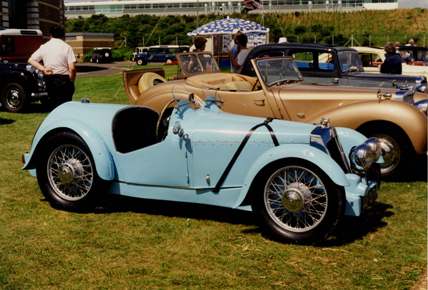
In all likelihood, his ocean liner would have dropped him in the UK. He almost certainly saw the SS 1 by Swallow Sidecar and Coachbuilding, the company that would be renamed "Jaguar" after WWII because of the negative connotations of the initials "SS." He probably wasn't as impressed by its overall boxiness as he was by the relative seamlessness of its contours (note that the door is slightly ajar) and that it was much lower to the ground than the current offerings by Ford or Lincoln. He may very well have appreciated what Aston Martin were doing, also. I doubt he'd have been very interested in Triumph's styling, although he may have appreciated their sporty proportions. There's a small possibility he spotted a Vale Special, built with Triumph components. But if the scarcity of images of it to be found today is any indication, and especially considering that it was handmade, the Vale couldn't have been particularly numerous at the time, either.

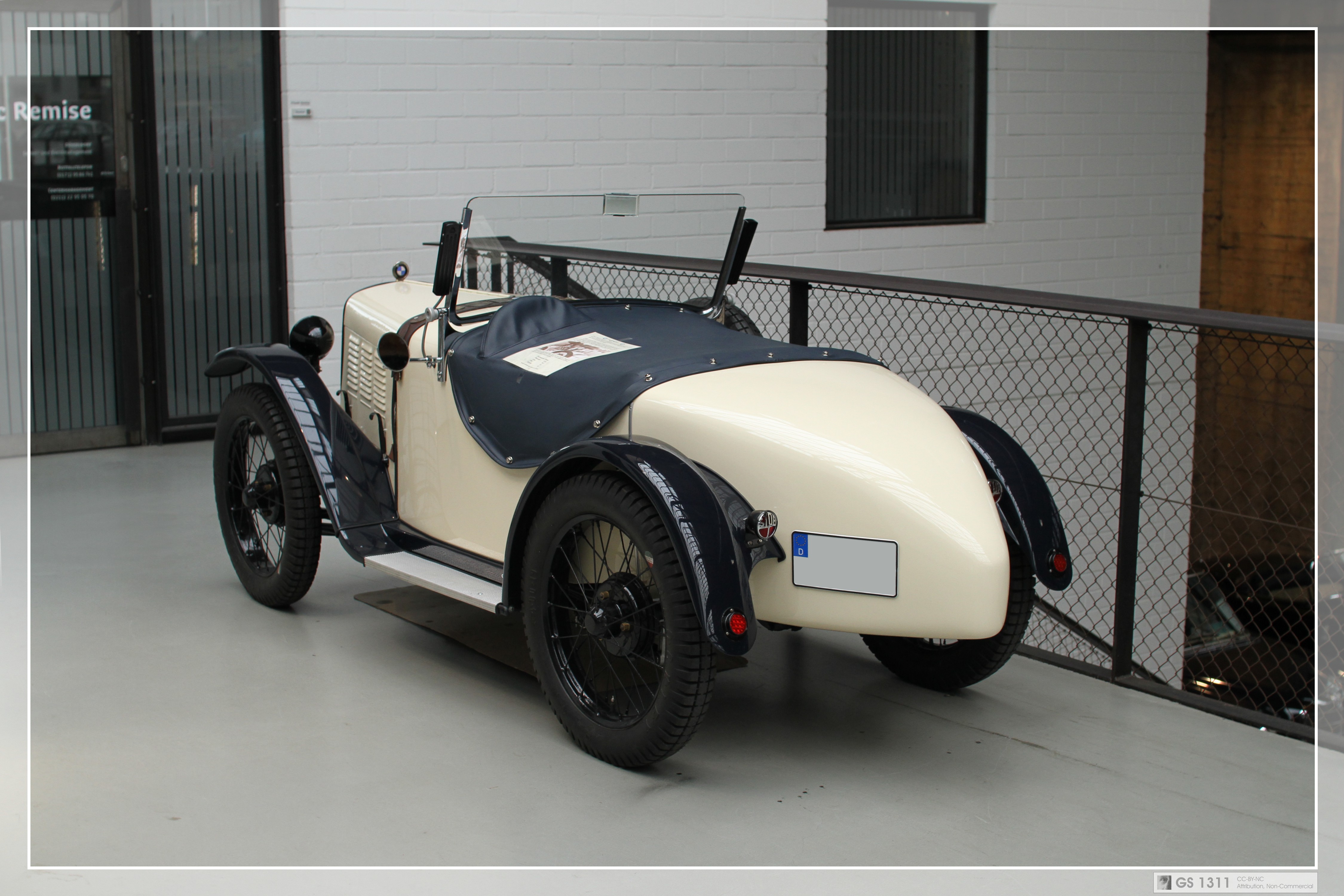
I can't be convinced that Ford went to Germany at all. Porsche was only a consulting firm at the time, anyway. There is some possibility that he saw the BMW Wartburg DA3, but it was kind of such a frumpy little thing that I can't imagine he would have been very impressed by it, not to mention that it almost looks taller than it does long. I also find it hard to believe that he could have seen the Mercedes-Benz SSK Trossi (named for its first owner, racecar driver Count Carlo Felice Trossi). First of all, very few of them were ever made, so it's not as if he were likely to have stumbled onto one on the road or even in a showroom. Plus, its design by Ferninand Porsche would have been so shockingly futuristic and--if I had to guess--astonishingly beautiful to Ford that its influence would have been far more apparent in what he ultimately created. I mean, for crying out loud, the thing looks like a freaking Batmobile. Although it does have the tapered tail, that could be found on plenty of race cars at the time. Mercedes' regular-production cars tended to be high and regal like the Rollses and Bentleys...and the concurrent Lincolns.

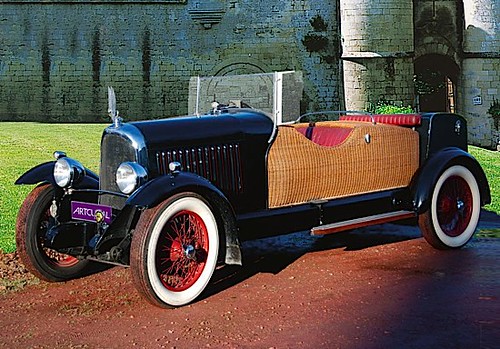
Traveling through France, there wasn't much to see. The Renaults and Citroëns were higher and boxier than the Fords, and neither Citroën nor Peugeot would introduce streamlined models until well into 1933 or 1934. There's really no way he couldn't have noticed the gorgeous Bugatti Type 50T, but I suspect it was a bit too voluptuous for him and not exactly what he was looking for. Avions Voisin, although decidedly interesting and even distinctive, rested somewhere between clunky and relatively bizarre.

Photo courtesy David van Mill.
In Italy, however, Ford very likely saw the Alfa Romeo 8C 2300 Spider Corsa designed by Ugo Zagato.

Public domain.


Perhaps it should come as no surprise that the car that appears to have impressed Ford the most was a Maserati. It was the 8C 3000, designed by the eldest Maserati brother, Alfieri, who passed away before he could see it finished. It has the correctly raked front end (a tiny hint of the streamlining to come) and the tapered rear end, in addition to the comparatively low profile of all the others.

Photo courtesy Gerry Swetsky.


When Ford returned home, he began talking to his company's head designer, E. T. "Bob" Gregorie, asking him to design a new car based on what he'd seen and liked in Europe. The first design was actually taller than Ford wanted, so Gregorie went back to the drawing board and finally created something much more streamlined. The normal Ford roadster chassis was modified and lowered by slinging it under the axle.

The tail extends further out in the back, making it appear longer and lower than a typical Ford. The new car was built by the Ford Aircraft Division using the same tubular aluminum construction methods, making the body extremely lightweight and strong. Along with its exhaust pipes, its headlights and taillights were sunk into the body itself, an innovation of Ford's for which I could find no European precedent, but which clearly made the overall design more streamlined still.

The final result of all of this was Edsel Ford's 1934 Model 40 Special Speedster.

Restoration and vintage photos courtesy Ford Hous

But this is not exactly what showed up at the 2012 Auto Show. Its engine had a tendency to overheat, so sometime before 1940, Gregorie redesigned the front end to allow better air cooling and in the process, make it more streamlined again. A winter freeze had cracked the Model 40 engine, so it was replaced with a 09A Mercury V8, the most powerful Ford V8 engine at the time.

I find the redesign a bit odd because it looks to me like the original grille was larger in area than the 1940 version. However, the overheating may very well have been as much about the location and direction of the incoming air as the amount or speed of it.

Aerodynamics had been discussed by Aristotle, da Vinci, Newton, and plenty other thinkers over the centuries. It remains a mystery why it was not considered by manufacturers of ground transportation vehicles--outside of racing--until the mid-1930s. Perhaps the Depression was sufficient impetus for car owners to consider the fuel economy even in vehicles that didn't necessarily travel very fast. I'd like to point out, though, that Buckminster Fuller's Dymaxion car didn't appear until 1933, the Chrysler Airflow and Union Pacific Railroad's M-10000 not until 1934. But as early as perhaps 1931, Edsel Ford was already on board with this upsurge of interest in the subject, enough so that during his European trip, he knew exactly what to look for. I think it proves him to have been a remarkably forward-thinking individual.

After the 1940 redesign, sadly, Edsel Ford got to enjoy his Speedster for only another three years before passing away in 1943. Strangely, the car was estimated to be worth only $200. This is considerably less than even a regular-production, bottom-line Ford, which probably would have sold for about $750 if most all manufacturing hadn't been focused on the war effort.

The Speedster kind of bounced around the country for a long time, from owner to owner. It went to Atlanta and then to Los Angeles, where someone replaced its engine and possibly painted it red with new leather upholstery to match. In 1957, it showed up back in Georgia and then went down to Florida, where it ended up with a man named John Pallasch. He had intended to fix it up but never finished. There it remained, stored in Pallasch's garage, abandoned and forgotten for almost forty years. It was sold twice more before Edsel Ford II arranged for it to be purchased for the museum at the Ford House. I don't know about that sale, but the previous owner had paid a justifiable $1.76 million for it at auction.

It was then handed over to RM Restorations in Canada. RM took the entire thing apart piece by piece and meticulously restored it to its 1939-40 iteration.

The newly restored Speedster was unveiled in 2011, but traveled with Lincoln for their auto show appearances.

That was how I first saw it in this glorious condition.

Presumably, once it's finished touring, it will go on permanent display at Ford House.


©2012, Ryan Witte

Wednesday, August 15, 2012

GET LOST: A New York Tour Guide's Guide to New York #12c

12c. TRANSPORTATION--BUSES

While there is very little subway crime these days, especially if you're not being stupid, buses have always had far less of it. Very late at night, this is a good cheap option because you can stay above ground. They may run extremely infrequently which is more of a pain if it's cold or bad weather. Mostly I mean wind and/or rain; subway stations are not climate controlled and can be hotter than outside in summer and just as cold in the winter. During the daytime, buses have the benefit over the subways that you can see more of the city's sights. Despite some dedicated bus lanes, however, buses are a very slow at getting you from point A to B due to traffic. In some cases, I'd even double my expected travel time.

Nonetheless, buses are indispensable for traveling crosstown (east/west). In addition to the diagonally oriented Broadway trains, there are really only three places to get east or west by subway: 14th, 42nd, and 57th Streets. The only other way is above ground. Especially where the island is divided by Central Park, it can actually be surprisingly fast and convenient by bus. Most times of the day, crosstown traffic zooms right through the park, covering two avenues of distance in about half the time it would take further downtown. The trip across the park by vehicle is not particularly scenic. The park's roadways are sunken below ground so as to not disturb its peaceful qualities. The trip across on foot is what you want if seeing the park itself is your goal.

Buses also get you much closer to a lot of destinations than the trains do. The north/south buses are extremely helpful for the great expanse east of Central Park. Although it's mostly residential, anyway, this area is served by only one subway line, the 4, 5, and 6. That's it, at least until the new Second Avenue line is complete in the year 4637. The Lexington Avenue trains can require walking many, many blocks to find the nearest station. Even if you have a pay-by-ride Metrocard, transferring from subway to bus and/or back again is a free transfer. It will often make good sense to use both forms of transport in a combination.

This is a discussion of the New York City public transit bus system. I'm not talking about the double-decker tour buses. Although I've never been on one, and actually wouldn't be caught dead on one, I must say I cannot imagine why anyone uses them. I'm sure I will convince no one who is already bent on utilizing this service for whatever reason. The hoards of people pouring out of those buses wearing plastic trashbags because they're sitting on the open-air top level of a tour bus in the middle of a freezing rainstorm look so completely idiotic, I can think of no money savings or convenience to using them that would be worth it. Personally, I would much, much rather go through the trouble of figuring out the public bus system (which is not rocket science, mind you). It may actually be cheaper in the long run, if planned properly, and far, far more civilized, relatively speaking.

©2012, Ryan Witte

12d. Taxi Cabs

Tuesday, July 31, 2012

Report on The Clock

How even the NYTimes was allowed to take this photo, I have no idea.
Well, today and tomorrow from 8AM to 10PM will be your last chance to see Christian Marclay's The Clock at Lincoln Center. If you did see it already, you may have spotted me on the line welcoming visitors and chatting with them. With the exception of our regular Crazies who showed up to harass us at all the most inopportune moments and the incident with the fire alarm going off, I'll have to say I had a ton of fun doing it. I got to speak with so many interesting and really nice people (and some of them cute, too). The question I probably answered a thousand times: "What's the best time to come to avoid the line?" The answer was "earlier is always better." The earlier in the day you can get there, the shorter the line will be. For the weekdays, 7:00 to 7:30AM probably.

Despite the fact that I clearly love coming up with puns and wordplay to title my posts, all the ones I might have for this post are understandably corny, clichéed, nauseating, or all of the above. So this is a mere "report."

For anyone who doesn't know about the piece, it took Marclay and his six assistants three years to put the whole thing together. He said he probably could have done it without assistants, but it would have taken more like ten years. The assistants' job was to do nothing but sit around watching movie after movie after movie all day long. It sounds like kind of a cushy job, but when I thought about it, I decided after about ten films, you'd be like "ugh, I don't want to be watching movies anymore!" The other thing about this project is how closely they had to have been paying attention to the screen. Some of the clips show clocks so tiny or so briefly you can barely catch them. In many of the clips, they must have had to freeze the frame and zoom in on it, even use a "sharpen" filter, to see what the clock even said. At the end of each day, they would report back to Marclay with all their findings. One of the assistants only seemed to be finding clips of people getting their heads blown off, so he was fired.

They scoured the entire history of cinema, from every part of the planet, going back 110 years or whatever. The final piece includes over 10,000 clips in all. In each of the clips, you either see a physical clock or watch showing the time, or a character in the film references a specific time of day. When that happens in the piece, it will be that exact time of day in real life. So it's actually a twenty-four-hour long "video collage" that operates as a working timepiece. It always tells you the correct time of day. It is quite seriously one of the coolest things I have ever seen.


Evidently a Wikipedia page has been building that catalogues every movie clip that viewers have identified and at what time they appear in the piece. I've been unable to locate it, but when I do, I'll edit this post to link to it.

The only films that produced no results, oddly, were Bollywood movies, which it was claimed had absolutely no clocks in them. We had a few guests from India on the line, so I mentioned this to them. One woman recalled a song that started out with "tick tick tick tick," but she couldn't remember what it was. She may have been thinking of this scene from Kal Aaj Aur Kal (1971), which does quite prominently have a clock in it. There's also this song from Shukriya (1972), and he's obviously holding a watch. There was evidently another similar song in a Bollywood film from the 1990s, but unfortunately all I could keep bringing up was the Ke$ha song. Another woman from India decided she would make it her mission to find clocks in Bollywood movies to prove this wrong. In any case, it may be that when clocks are mentioned or appear, they aren't shown clearly enough or don't accurately reference a specific time of day in the film's narrative.

In doing my research, I was reminded that I knew Christian Marclay's work already. Many, many, many years ago, I'll never remember where (possibly London?), I saw his Tape Fall (1989), wherein a reel-to-reel tape player plays the sound of trickling water as the tape trickles down to slowly form a cone-shaped pile on the gallery floor. At the time, I thought that was one of the coolest things I'd ever seen, despite it being a bit of a one-liner.

Marclay has done a lot of different kinds of work including avant-garde music. As a DJ, for instance, he would break a few records, tape them back together again, and then play them on the turntable, which would cause the stylus to bounce around madly and likely destroyed a needle or two. He apparently does not want to be known exclusively for The Clock. A struggling up-and-coming artist might be inclined to recommend he not resent the world-wide success of this piece, which has put him quite decidedly smack in the middle of the map of Contemporary Art. I can also understand his fear of being considered a one-trick pony, however.

I think the great appeal of The Clock, perhaps in contrast to some of his other more unusual works, comes from the fact that it is an astonishing, sophisticated, and mesmerizing work of Contemporary Art, but at the same time, to enjoy the piece the layperson really needs only to like movies. And who doesn't like movies? Sure, there are tons of obscure French black-and-white films from the 1930s and whenever else. But in a one-hour segment, you'd be likely to find five to ten films you've seen before and easily twice as many actors who you recognize.

There are six copies of The Clock in existence at the moment. It's sold on a disc for $150,000, which I realized is about what you'd probably pay for a rare antique Cartier watch when I thought about it. The copy shown here was purchased by a Lincoln Center board member as a gift to the Museum of Modern Art, with the provision that it could be shown at LC first. The MoMA plans to show it again this fall, but I don't have any details about that.

A few people asked if you'd be more likely to see different parts of the twenty-four-hour piece if you were to see it in, say, Sydney, Australia (where it was shown, in fact). The piece is actually a program that you load onto your computer. Once loaded, it locks onto that computer's clock, which is synched to the correct time via the internet. For anyone who's never looked up the atomic clock in Greenwich, England, your computer will be synched to it down to the very second. So when you start up The Clock program, it will automatically go straight to the part of the collage to show the correct time wherever on the planet you happen to be. If you start it running at 3:37PM, it will automatically show you 3:37PM. It's one of the things I found most awesome about the piece, and many people to whom I described that felt the same.

Marclay has a lot of rules for the way this piece may be shown. It may not be shown in a movie theater, but should be shown in something closer to an art gallery. Light and sound must be controllable and controlled. The white couches are to his specifications, rather than chairs. Viewers must be allowed to stay for as long as they wish. And while the artist does make $150,000 a copy, it must always be shown for free, which I suspect was to some degree his copyright loophole for the use of all these clips. He also hinted at the idea that, to paraphrase, if you're doing something great with the material (which he has), people tend to kind of look the other way and not make a legal fuss. The other thing I mentioned to people who asked about this is that his use of the clips is almost blandly neutral. He's not making any particular statement by putting them into this new context, much less anything defamatory or politically sensitive. It feels much more like what you see is what you get. The statements it makes about the rhythms of daily life or our perception of the passage of time are on a higher plane of comprehension entirely.

It's not just chopped together like some amateur series of clips in a YouTube video. It's fully edited together extremely seamlessly. He worked with a sound designer, as well, so the sound overlaps from one edit to the next. Some musical backgrounds overlap several video clips from different movies. I think it's one of the main reasons the work is so very hypnotic. People would go in planning to stay only an hour and would depart three, four, five hours later entirely shocked that they had stayed so long and hardly even realized it.

One of the questions we would often get was somewhat funny because the answer was so potentially confusing, especially on the weekends when we were running The Clock continuously from 8AM Friday until 10PM Sunday: "How long does it last?" "Twenty-four hours." "No, no, I mean what's the length of the video?" "Twenty-four hours." "No, I mean from the start of it to the end of it, how long does it last?" "The piece actually has a duration of twenty-four hours. You can literally sit there and watch it for twenty-four hours and not see the same thing twice." "Oooooohhh...wow!" At last count that I heard, we had about six people who stayed for the entire twenty-four-hour work. A few of them were film students, not surprisingly.

Other people would come back over and over again, not just our regular Crazies who camp out at the Atrium every day, but people who had planned to visit The Clock only once. They got so hooked that they simply had to come back again to see different times of the day. I started to recognize familiar faces after a while. This really nice little kid, maybe nine or ten, who helps his dad run the food cart at the end of the block, stood on line a few different times. "You're back again. It's really cool, isn't it?" I asked him. He grinned and nodded enthusiastically.

One woman told me that over the past year or so and in different cities (she was from Los Angeles), she'd seen all twenty-four hours of The Clock minus one eighteen-minute segment starting at 8:53PM. At around 8:40, she was still easily a half-hour away from getting in. We were ordered to restrict admittance to this thing as if it were Fort Knox, and several of the managers tyrannically stuck to this to an irritating fault. The one on duty that night, thankfully, was much more pleasant, and I really wanted to help this lady complete her impressive twenty-four hour journey there at Lincoln Center. I was sort of vicariously excited along with her. So in a hushed conversation with the manager, I asked if it wouldn't be possible to bend the rules a little. Happily, he snuck her out of the line at which point I gave her a quick grin and a thumbs up. She can now say she has seen the entire piece. Congratulations! Had all but the most heartless, petty person on that line known what was happening, I can't believe they'd have protested knowing how close she was.


I didn't work the front door very often, but it felt like a cross between the velvet ropes at Studio 54 and the pearly gates, depending on how long the line was. All the Crazies were particularly attracted to this spot. At one point, a gentleman passing by stopped to inform me that he had been harassed by the attendants inside the gallery and was very upset about it. He had been sitting there quietly watching and minding his own business, and the gallery attendants had had the nerve to hassle him for having taken his pants off. "Usually the ladies are begging me to do that," he said later. He'd evidently visited twice and took his pants off both times. After he'd walked away, someone in the line who'd overheard his complaint asked, "boxers or briefs?" But the answer from one of the reps who'd been there that day was almost as bad as "neither." 

A jock strap.

I had intermittently been announcing the rules inside the gallery to each group of people as they approached the door to go in, so I stepped out and addressed them a second time to say, "ladies and gentlemen, pants are required at all times inside the gallery." Everyone had a good laugh over that. Henceforth this individual was unofficially referred to as "No Pants Guy."

There were quite a few celebrity sightings, including Anjelica Huston and Stephen Sondheim, both of whom I missed. I did get to see actors Joel Grey and Wallace Shawn and fashion photographer Bill Cunningham, who was wearing blue. I'm not sure you could call LC president Reynold Levy a "celebrity" but he certainly wields power.

One of the best things about working there while this was going on is that I myself was able to see a total of about nine or ten hours of it on and off. I would have seen some of it regardless, but very likely I wouldn't have seen quite so much if I weren't getting paid to be there at the same time. I had heard the rumors that the best time to see was Midnight. The lady who had seen all of it but eighteen minutes confirmed this with no doubt in her voice. For most of the piece, Marclay wanted the most banal aspects of daily life (why Heads-Blown-Off Guy was fired). In other words, he didn't want a bunch of car chases, explosions, and gun fights, although there are a few of those here and there. I think it was a wise decision, because what you get in the end are these sort of pulsing rhythms of life and the currents of what we most often do at specific times of day and night. Even at Noon, although he could hardly have left out High Noon (and a brilliant movie that remains on my Top Ten list: Once Upon a Time in the West), and the tension of waiting for the clock to slowly and finally strike Twelve, he allowed no payoff to that tension. At 12:01, nothing major happens, life kind of just returns back to normal.

At Midnight, on the other hand, for pretty much just this one small section of this huge work, he allowed himself to do something big. It's a reason that when pressed for an answer to this question, I went with the suspicion that as the piece was laid out by Marclay in linear fashion, the beginning would actually have been 12:00:01AM. The clips come rapid fire. There are explosions. It pays off. I did get to see it on Friday, but unfortunately I was still on duty and somewhat distracted. I also didn't stay to see much more, because I didn't think I'd need to. The plan was to stay after my shift on Saturday to watch it, and once and for all really study it. I even asked a coworker to save a spot for me on the floor.

As my luck would have it, Saturday the 28th was the night that, at pretty much the most perfect moment to ruin Midnight for everyone, the fire alarm went off and everyone had to be evacuated. I can say no more about what happened than simply that or LC will hand me my ass on a platter. Up to a certain point, the hope was still buzzing that it might be cleared up and we might get back in before Midnight. Sadly, it was just not meant to be. At around 12:05 or so, I left the disappointed faces in the "already inside the gallery" line and returned home. I overheard the suggestion being made that they play Midnight for the crowd and then fast-forward again to the correct time, but since the program is set to work as a clock as I described above, this never would have been possible. Other folks were murmuring about Lincoln Center changing their schedule to show it again overnight on Sunday, but that would have been all but practically impossible to arrange. There is a small chance that I may try to get in to see Midnight when it shows at the MoMA, but the showing where I already work was clearly going to be infinitely easier for me and less time-consuming. Such is life, I suppose.

For anyone who has not yet seen this epic masterpiece, I urge you to please go. Earlier is better. Whatever length of line you find when you get there, I can genuinely say it is worth every minute.

©2012, Ryan Witte