12d. TRANSPORTATION--TAXI CABS
It might seem that taxis would be faster than waiting for trains, but this is completely true only at night. During the day, for all the same reasons that most New Yorkers don't own cars, it can actually be a huge waste of time and money. The one thing they do offer is privacy and comfort compared to the trains. Late at night, the one time I might certainly recommend taking a cab, you can get from just about any destination to another in the central part of Manhattan in less than fifteen minutes and for under fifteen dollars including the tip. Often it's much less.
During the daytime, cabs are only worth taking for distances between around fifteen and forty blocks (street blocks, that is, not avenue blocks). Less than that and, considering the cost and slowness, you may as well just walk it. Much more than that and you'd likely get there much faster and for much less money by taking the subway. One exception is if you have luggage or other heavy items on you, especially trips to and from the airport.
There are fifteen different vehicles authorized by the Taxi & Limousine Commission, the most recent of which, the Nissan NV200 shown here, was introduced as the "Taxi of Tomorrow" at this year's auto show. A few of them, namely the Mercedes E350, Volkswagen Golf, and AM General MV-1, I have never once seen on the street. For those who may be environmentally conscious, eight of the fifteen have hybrid models available. The NV200 will soon be available as an electric vehicle, as will the Volkswagen Jetta. The Jetta is also available in a version which burns biofuel. I have every confidence the city chose these particular models for that very reason. The number of hybrid taxis continues to rise, and customers appear to prefer them. Although they certainly produce less pollution as well, resources must also be tapped for maintenance and repair, which produce different kinds of pollutants, and have been so costly as to call into question the benefit of savings on fuel usage. In fact, a plan to replace every New York City taxi in use to hybrid models by a certain year had to be scrapped for this reason.
The next thing to discuss is hailing. I'm always shocked by how often I see people who appear comfortable in the city who don't seem to understand how the fare lights work. They stand there waving their hand in the air becoming increasingly agitated and insulted as taxi after taxi passes by them. There has been discussion about changing the fare lights to make them more intuitive and easier to understand, but until that happens, here it is.
When I say fare lights, I refer to the little light box on the roof right above the windshield, facing front. It has three settings. All the lights off means the cab has a fare on board and is unavailable. The taxi's ID number lit alone means the cab is available to accept a fare. If this cab passes you by, you have right to be insulted unless the driver is unable to merge lanes or some other issue. On both sides of the ID number are two more lights that read "off duty." This is fairly self-explanatory unless you're too far away or didn't think to read what it says. If all the lights are lit, the cab is unavailable. Yes, I know, that's stupid. But that's how it works.
There is a provision on off-duty cabs, however. Since the driver is obviously traveling somewhere, what this usually means is that he or she is changing shifts. Most cabs are shared between two drivers, one taking the day shift, the other taking the night shift. The bizarre thing about the shift change is that it happens when you'd least expect it, between 4:00 and 5:00PM. It has to do with ensuring that both shifts include a rush hour, and avoiding the day shift starting at, say, 2AM. But it means that when you'd most want to have a cab take you somewhere, there aren't any.
In any case, you may occasionally see an off-duty driver stopping for a potential fare, but rolling down the window first to ask where the person needs to go. If the driver is going generally in the same direction as the potential customer, he or she will usually be happy to pick up one last customer before quitting time. Don't be insulted if the driver simply says "sorry, no," and speeds off. This just means your destination is too far out of the way. The taxi stations are mostly out in Queens somewhere and the driver will be fined for getting the car back late.
It's possible that if you have an emergency, you could offer an off-duty driver more money to take you, for instance, double what the meter says. I've never seen anyone try this to know if it would work. Likely more money wouldn't make a difference unless you're willing to cover the driver's potential thirty-dollar late fee.
Typically the most people a single taxi will agree to take is four,
unless you get one of the minivan ones with more seats. If you're
overflowing the back, some drivers prefer you ask first before taking
the front seat. If you have more people than the vehicle is supposed to
hold, you'll need to ask the driver if he or she is willing to
accommodate you, and it's probably not a bad idea to offer some extra
money for he or she taking the risk. Most of the time you'll need to split your group between two cabs.
Once you've gotten into the cab there is one crucial thing you need to have for where you want to go: the street and avenue intersection ("61st & Lex") or mid-block location between two others ("39th between 2nd & 3rd Avenue"). The numbered street address of the specific building is great to have, but unless it's on a major artery, the driver is likely to just guesstimate into what block that building address falls. Certainly smart phones are quickly making this kind of advice obsolete, but I still think it's wise to do your own homework.
I used to know a person with whom it was so embarrassing to take cabs because he would get in and order the driver to take us to "Such-and-Such Obscure Expensive French Restaurant, please," as if the driver should have any clue where that is. Then he would proceed to complain loudly enough for the driver to hear him how New York City cab drivers don't know where anything is. In a way, it was extra rude because we'd be going someplace this unfortunate cab driver probably couldn't even afford to go.
In some cities like London, taxi drivers must pass an extensive exam and know exactly how to get to just about every last random address in the city. Unlike the potentially confusing city of London, likely because of the numbered grid, New York cab drivers don't have to memorize every street to get the job. Whatever you think about that, it's just how it is. Central Manhattan, where most people are going, is easy enough. But the city as a whole is a big place. There are enormous stretches of eastern Brookyn where I have never even set foot, and in a car, would be hopelessly lost in five minutes.
Most drivers know the location of major sites in Manhattan, especially things like train stations and larger cultural venues, because these are the places where they're guaranteed to find fares. But some random little hotel? Forget it. Know where you're going. In the outer boroughs, it can often be necessary to have a vague idea of what route you need to take, as well.
There's another unfortunate reason why it's so important to know exactly where you're going. I'm sorry to have to say this, but the driver will probably try to rip you off. The good news is that there's nothing that can be done to mess with the meter. The meter is automatic, must be used for every ride, and it's calculated pretty well to benefit both the driver and the passenger fairly, regardless of whether you're speeding along fast or stopped in horrible traffic. But I cannot tell you how many times I've been in a cab with someone who the driver only suspects is from out of town and suddenly I find we're going around and around in circles, or taking the, ahem, "scenic route" to our destination.
Usually they won't screw around if you're going to the airport. They know you'll lose your marbles if you think you're going to miss your plane. But if you're headed to a hotel, the driver will probably assume you have no idea where you are and won't notice an extra trip around the block. A lot of the new cabs have a screen in the back which includes GPS mapping of your route, but if you don't know the city geography and aren't watching the screen extremely closely the entire time, this might not help all that much--and give you motion sickness in the process.
A friend who worked in hospitality recently made me aware of a really smart move in this situation: telling the driver he or she missed your turn and asking that the meter please be stopped. Give him or her the benefit of the doubt that it may have been an honest mistake. Insinuating that the person is a crook won't do anything but make the scene needlessly ugly. Remember that a lot of the streets do go only one way, and that the driver may have had no choice but to circle around. Getting out on the nearest corner and walking an extra fifty yards to your destination rather than being taken right up to its front door can help to avoid this question, also. If the driver refuses to turn off the meter and you are certain you were being taken on the long route, don't tip. Making a mental note of the driver's ID number is never a bad idea--it's only four digits, easy to memorize--especially if you later discover your cell phone fell out of your pocket in the cab.
And please do tip otherwise, especially if you got there faster than you thought you would or the driver helped with your lead-bullion-filled luggage. Driving a cab is a thankless job with obnoxious passengers, traffic accidents, nutjobs, and muggers. Cab drivers aren't living in twelve-bedroom mansions as it is. A lot of them are honest folks working their way through college, hardworking parents just trying to feed their kids, or retirees for whom social security isn't enough. Lastly, do not ever assume, just because your driver doesn't speak flawless English and is likely newly immigrated to the United States, that he or she doesn't have two doctorates in neurobiology from the best university back home. Trust me, a lot of them do, but those jobs aren't so easy to find here, at least not immediately upon arriving.
©2012, Ryan Witte
12e. Livery Cabs
Friday, October 5, 2012
Sunday, September 2, 2012
Prodigal Roadster
![]() |
| Photo courtesy RM Auctions. |
| Photo courtesy Oregon CCCA. |
The Lincoln Model K was introduced in 1931. In 1932 it was split into two lines, the KA and the KB. The 1932 Lincoln Model KA V8 Victoria shown here was clearly fancier, more powerful, and more luxuriously detailed than a Ford. It sold for a little over $4400 in '32, almost $70,000 by today's standards. Despite the outrageous price difference, it's not all that significantly different in style.
In 1932, Edsel Ford went on a trip to Europe. Who knows if his primary goal was to get a look at the European cars, but there probably can be not the slightest question that someone as intimately involved with the automobile industry would have his eye on every new car he saw. What's more, if a man like Edsel Ford were visiting Europe, I can't imagine he wasn't eating most of his dinners at the homes of people like Aston Martin founder Lionel Martin and Bindo Maserati. I don't know exactly where he went or what he saw there, but I'd like to try to piece it back together using some possibilities.
![]() |
| Photo courtesy Steve Sexton. |
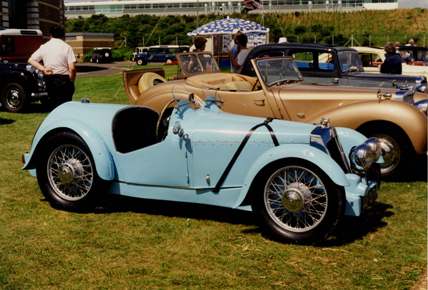
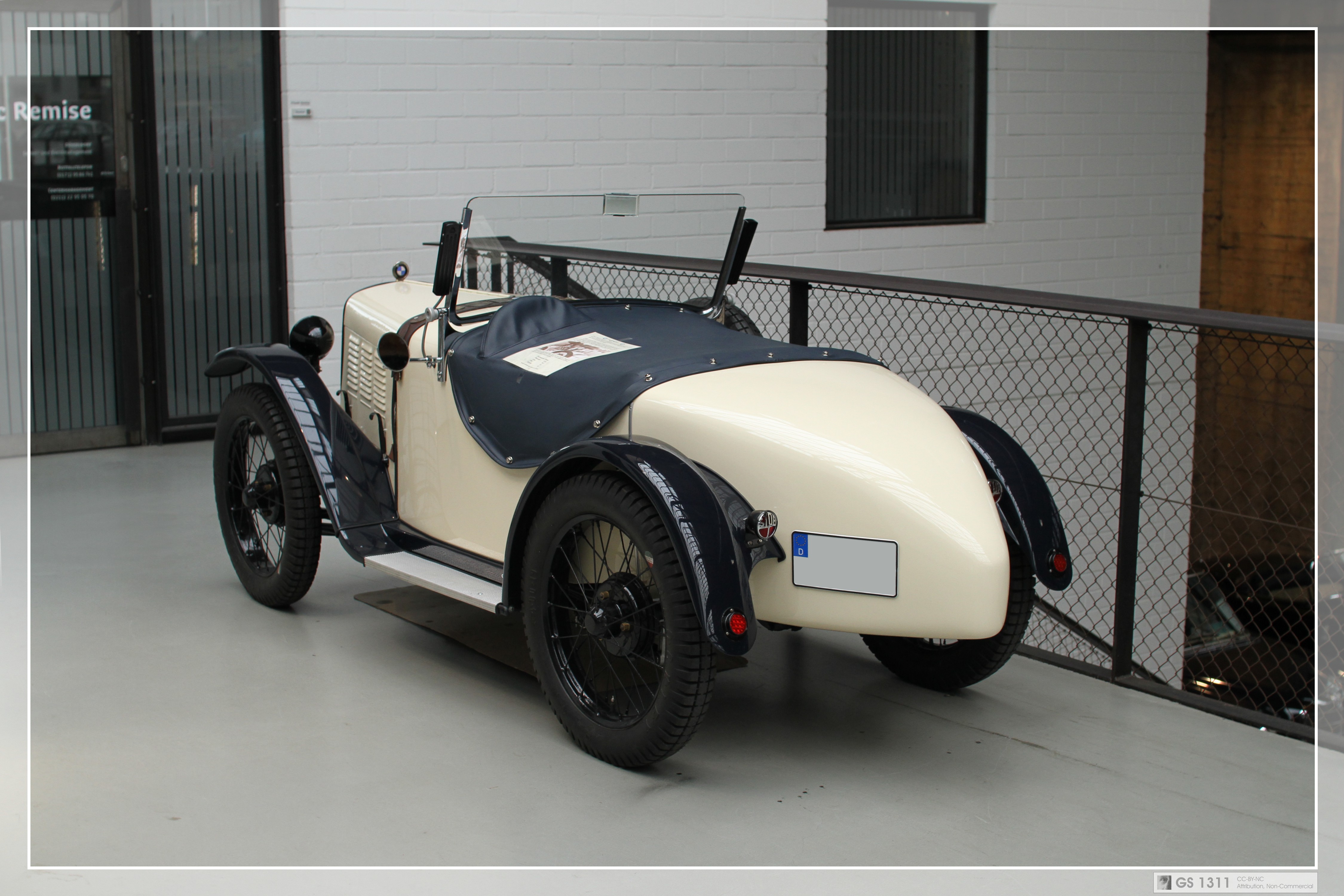
I can't be convinced that Ford went to Germany at all. Porsche was only a consulting firm at the time, anyway. There is some possibility that he saw the BMW Wartburg DA3, but it was kind of such a frumpy little thing that I can't imagine he would have been very impressed by it, not to mention that it almost looks taller than it does long. I also find it hard to believe that he could have seen the Mercedes-Benz SSK Trossi (named for its first owner, racecar driver Count Carlo Felice Trossi). First of all, very few of them were ever made, so it's not as if he were likely to have stumbled onto one on the road or even in a showroom. Plus, its design by Ferninand Porsche would have been so shockingly futuristic and--if I had to guess--astonishingly beautiful to Ford that its influence would have been far more apparent in what he ultimately created. I mean, for crying out loud, the thing looks like a freaking Batmobile. Although it does have the tapered tail, that could be found on plenty of race cars at the time. Mercedes' regular-production cars tended to be high and regal like the Rollses and Bentleys...and the concurrent Lincolns.
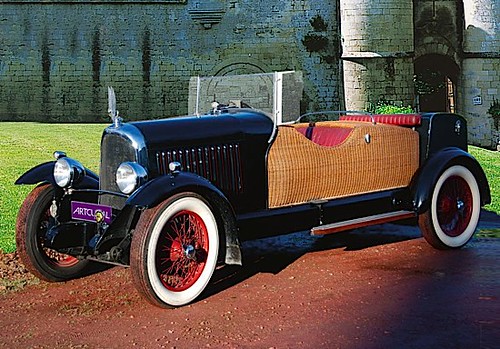
Traveling through France, there wasn't much to see. The Renaults and Citroëns were higher and boxier than the Fords, and neither Citroën nor Peugeot would introduce streamlined models until well into 1933 or 1934. There's really no way he couldn't have noticed the gorgeous Bugatti Type 50T, but I suspect it was a bit too voluptuous for him and not exactly what he was looking for. Avions Voisin, although decidedly interesting and even distinctive, rested somewhere between clunky and relatively bizarre.
![]() |
| Photo courtesy David van Mill. |
![]() |
| Public domain. |
Perhaps it should come as no surprise that the car that appears to have impressed Ford the most was a Maserati. It was the 8C 3000, designed by the eldest Maserati brother, Alfieri, who passed away before he could see it finished. It has the correctly raked front end (a tiny hint of the streamlining to come) and the tapered rear end, in addition to the comparatively low profile of all the others.
![]() |
| Photo courtesy Gerry Swetsky. |
When Ford returned home, he began talking to his company's head designer, E. T. "Bob" Gregorie, asking him to design a new car based on what he'd seen and liked in Europe. The first design was actually taller than Ford wanted, so Gregorie went back to the drawing board and finally created something much more streamlined. The normal Ford roadster chassis was modified and lowered by slinging it under the axle.
The tail extends further out in the back, making it appear longer and lower than a typical Ford. The new car was built by the Ford Aircraft Division using the same tubular aluminum construction methods, making the body extremely lightweight and strong. Along with its exhaust pipes, its headlights and taillights were sunk into the body itself, an innovation of Ford's for which I could find no European precedent, but which clearly made the overall design more streamlined still.
The final result of all of this was Edsel Ford's 1934 Model 40 Special Speedster.
![]() |
| Restoration and vintage photos courtesy Ford Hous |
But this is not exactly what showed up at the 2012 Auto Show. Its engine had a tendency to overheat, so sometime before 1940, Gregorie redesigned the front end to allow better air cooling and in the process, make it more streamlined again. A winter freeze had cracked the Model 40 engine, so it was replaced with a 09A Mercury V8, the most powerful Ford V8 engine at the time.
I find the redesign a bit odd because it looks to me like the original grille was larger in area than the 1940 version. However, the overheating may very well have been as much about the location and direction of the incoming air as the amount or speed of it.Aerodynamics had been discussed by Aristotle, da Vinci, Newton, and plenty other thinkers over the centuries. It remains a mystery why it was not considered by manufacturers of ground transportation vehicles--outside of racing--until the mid-1930s. Perhaps the Depression was sufficient impetus for car owners to consider the fuel economy even in vehicles that didn't necessarily travel very fast. I'd like to point out, though, that Buckminster Fuller's Dymaxion car didn't appear until 1933, the Chrysler Airflow and Union Pacific Railroad's M-10000 not until 1934. But as early as perhaps 1931, Edsel Ford was already on board with this upsurge of interest in the subject, enough so that during his European trip, he knew exactly what to look for. I think it proves him to have been a remarkably forward-thinking individual.
After the 1940 redesign, sadly, Edsel Ford got to enjoy his Speedster for only another three years before passing away in 1943. Strangely, the car was estimated to be worth only $200. This is considerably less than even a regular-production, bottom-line Ford, which probably would have sold for about $750 if most all manufacturing hadn't been focused on the war effort.
The Speedster kind of bounced around the country for a long time, from owner to owner. It went to Atlanta and then to Los Angeles, where someone replaced its engine and possibly painted it red with new leather upholstery to match. In 1957, it showed up back in Georgia and then went down to Florida, where it ended up with a man named John Pallasch. He had intended to fix it up but never finished. There it remained, stored in Pallasch's garage, abandoned and forgotten for almost forty years. It was sold twice more before Edsel Ford II arranged for it to be purchased for the museum at the Ford House. I don't know about that sale, but the previous owner had paid a justifiable $1.76 million for it at auction.
It was then handed over to RM Restorations in Canada. RM took the entire thing apart piece by piece and meticulously restored it to its 1939-40 iteration.
The newly restored Speedster was unveiled in 2011, but traveled with Lincoln for their auto show appearances.
That was how I first saw it in this glorious condition.
Presumably, once it's finished touring, it will go on permanent display at Ford House.
©2012, Ryan Witte
Labels:
1930s,
automobiles,
Ford,
industrial design,
Lincoln,
Maserati,
nyias
Wednesday, August 15, 2012
GET LOST: A New York Tour Guide's Guide to New York #12c
12c. TRANSPORTATION--BUSES
While there is very little subway crime these days, especially if you're not being stupid, buses have always had far less of it. Very late at night, this is a good cheap option because you can stay above ground. They may run extremely infrequently which is more of a pain if it's cold or bad weather. Mostly I mean wind and/or rain; subway stations are not climate controlled and can be hotter than outside in summer and just as cold in the winter. During the daytime, buses have the benefit over the subways that you can see more of the city's sights. Despite some dedicated bus lanes, however, buses are a very slow at getting you from point A to B due to traffic. In some cases, I'd even double my expected travel time.
Nonetheless, buses are indispensable for traveling crosstown (east/west). In addition to the diagonally oriented Broadway trains, there are really only three places to get east or west by subway: 14th, 42nd, and 57th Streets. The only other way is above ground. Especially where the island is divided by Central Park, it can actually be surprisingly fast and convenient by bus. Most times of the day, crosstown traffic zooms right through the park, covering two avenues of distance in about half the time it would take further downtown. The trip across the park by vehicle is not particularly scenic. The park's roadways are sunken below ground so as to not disturb its peaceful qualities. The trip across on foot is what you want if seeing the park itself is your goal.
Buses also get you much closer to a lot of destinations than the trains do. The north/south buses are extremely helpful for the great expanse east of Central Park. Although it's mostly residential, anyway, this area is served by only one subway line, the 4, 5, and 6. That's it, at least until the new Second Avenue line is complete in the year 4637. The Lexington Avenue trains can require walking many, many blocks to find the nearest station. Even if you have a pay-by-ride Metrocard, transferring from subway to bus and/or back again is a free transfer. It will often make good sense to use both forms of transport in a combination.
This is a discussion of the New York City public transit bus system. I'm not talking about the double-decker tour buses. Although I've never been on one, and actually wouldn't be caught dead on one, I must say I cannot imagine why anyone uses them. I'm sure I will convince no one who is already bent on utilizing this service for whatever reason. The hoards of people pouring out of those buses wearing plastic trashbags because they're sitting on the open-air top level of a tour bus in the middle of a freezing rainstorm look so completely idiotic, I can think of no money savings or convenience to using them that would be worth it. Personally, I would much, much rather go through the trouble of figuring out the public bus system (which is not rocket science, mind you). It may actually be cheaper in the long run, if planned properly, and far, far more civilized, relatively speaking.
©2012, Ryan Witte
12d. Taxi Cabs
While there is very little subway crime these days, especially if you're not being stupid, buses have always had far less of it. Very late at night, this is a good cheap option because you can stay above ground. They may run extremely infrequently which is more of a pain if it's cold or bad weather. Mostly I mean wind and/or rain; subway stations are not climate controlled and can be hotter than outside in summer and just as cold in the winter. During the daytime, buses have the benefit over the subways that you can see more of the city's sights. Despite some dedicated bus lanes, however, buses are a very slow at getting you from point A to B due to traffic. In some cases, I'd even double my expected travel time.
Nonetheless, buses are indispensable for traveling crosstown (east/west). In addition to the diagonally oriented Broadway trains, there are really only three places to get east or west by subway: 14th, 42nd, and 57th Streets. The only other way is above ground. Especially where the island is divided by Central Park, it can actually be surprisingly fast and convenient by bus. Most times of the day, crosstown traffic zooms right through the park, covering two avenues of distance in about half the time it would take further downtown. The trip across the park by vehicle is not particularly scenic. The park's roadways are sunken below ground so as to not disturb its peaceful qualities. The trip across on foot is what you want if seeing the park itself is your goal.
Buses also get you much closer to a lot of destinations than the trains do. The north/south buses are extremely helpful for the great expanse east of Central Park. Although it's mostly residential, anyway, this area is served by only one subway line, the 4, 5, and 6. That's it, at least until the new Second Avenue line is complete in the year 4637. The Lexington Avenue trains can require walking many, many blocks to find the nearest station. Even if you have a pay-by-ride Metrocard, transferring from subway to bus and/or back again is a free transfer. It will often make good sense to use both forms of transport in a combination.
This is a discussion of the New York City public transit bus system. I'm not talking about the double-decker tour buses. Although I've never been on one, and actually wouldn't be caught dead on one, I must say I cannot imagine why anyone uses them. I'm sure I will convince no one who is already bent on utilizing this service for whatever reason. The hoards of people pouring out of those buses wearing plastic trashbags because they're sitting on the open-air top level of a tour bus in the middle of a freezing rainstorm look so completely idiotic, I can think of no money savings or convenience to using them that would be worth it. Personally, I would much, much rather go through the trouble of figuring out the public bus system (which is not rocket science, mind you). It may actually be cheaper in the long run, if planned properly, and far, far more civilized, relatively speaking.
©2012, Ryan Witte
12d. Taxi Cabs
Labels:
Get Lost,
New York City,
tourism,
transportation,
travel
Subscribe to:
Posts (Atom)