Showing posts with label Daniel Zeller. Show all posts

Wednesday, October 21, 2009

Pink Abstraction

Once again, I'm seeing way more things lately than I have time to write about. One of the shows was Georgia O'Keeffe--Abstraction at my favorite museum, the Whitney. There can hardly be any doubt the Whitney was at least in part prompted to mount this show by the recent film with Joan Allen in the role of the artist.

Alfred Stieglitz, Georgia O'Keeffe (1918, gelatin silver print)
--Image courtesy The Artist's Magazine.
There was a lot of discussion about her relationship with Alfred Stieglitz. He championed her work in his gallery, and when she moved to New York, they quickly fell in love and became this sort of crazy Power Couple in the art scene. They kind of remind me of Matthew Barney and Björk. The press would eat up everything they did, basically. He took a series of nude photographs of her, many of which are on display in a dedicated museum gallery. The photographs cemented her image in the public consciousness, but also gave her a reputation, true or not, of being this kind of free-wheeling, free-thinking, Bohemian modern woman.

It's kind of a shame how fantastic and important an artist Georgia O'Keeffe is, because she's become so stigmatized for me. It's the little old ladies. I said to my friend who works there, "the little old ladies just looove O'Keeffe, don't they?" He was like, "yeah, that's all we've been getting lately."

When I showed up, I was lucky to find a gallery tour just beginning, so I started to listen. This docent was so fantastic that I followed her for her entire talk, which I almost never do. A lot of other people thought so, too; there were about thirty or thirty-five little old ladies who stayed with the docent and...one other guy and myself. Then there's this third guy, maybe in his early forties, who was like 225 pounds of muscle and made for a kind of amusing contrast. It was an olfactory experience, too, since each little old lady was surrounded a heavy cloud of some different sickly sweet, flowery perfume, and one of them was--audibly--passing gas. I find it so bizarre that the little old ladies worship O'Keeffe so readily since the woman was, essentially, painting her private parts.

Georgia O'Keeffe, Blue Line (1919, oil on canvas)
--Image courtesy The Art Database.
This one is probably not safe for work or for underaged readers: Alfred Stieglitz, Georgia O'Keeffe (1922, gelatin silver print). I absolutely love the irony of how difficult this image is to find. As practically impossible as it is to avoid seeing pornography on the internet at least twelve times a day, this photograph, which is indubitably a work of art, is sorely hidden behind pages and pages of Googling.

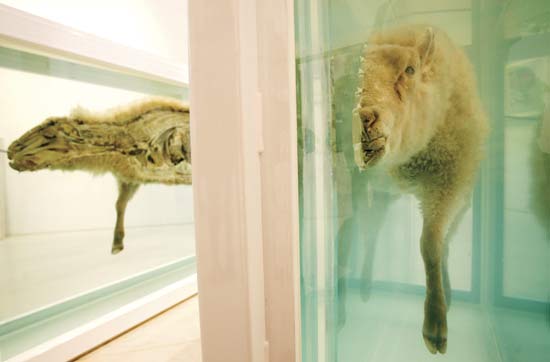
It's true that she was one of the only influential female artists to be recognized as such during her lifetime, which is empowering and must have been a great deal more so for women of the generation who grew up in the 1940s. If you're not paying attention, she's just painting nature, and with extraordinary use of color. Her work is without question pretty. In that sense, her work is very "safe" by today's standards, especially compared to someone like Damien Hirst, showing us the insides of animals. But I just thought it was fairly obvious to everyone that she was painting female genitalia. Doesn't that kind of stuff make little old ladies uncomfortable? I don't get it.

Although women are legally permitted to go topless anywhere that men are, and this is also clearly a work of art, I'd prefer to keep things clean on here: Alfred Stieglitz, Georgia O'Keeffe--Breasts (1919, gelatin silver print). Unfortunately, the work in the show that most alludes to this, Alligator Pears (1923, oil on board), is from a private collection and impossible to find online.

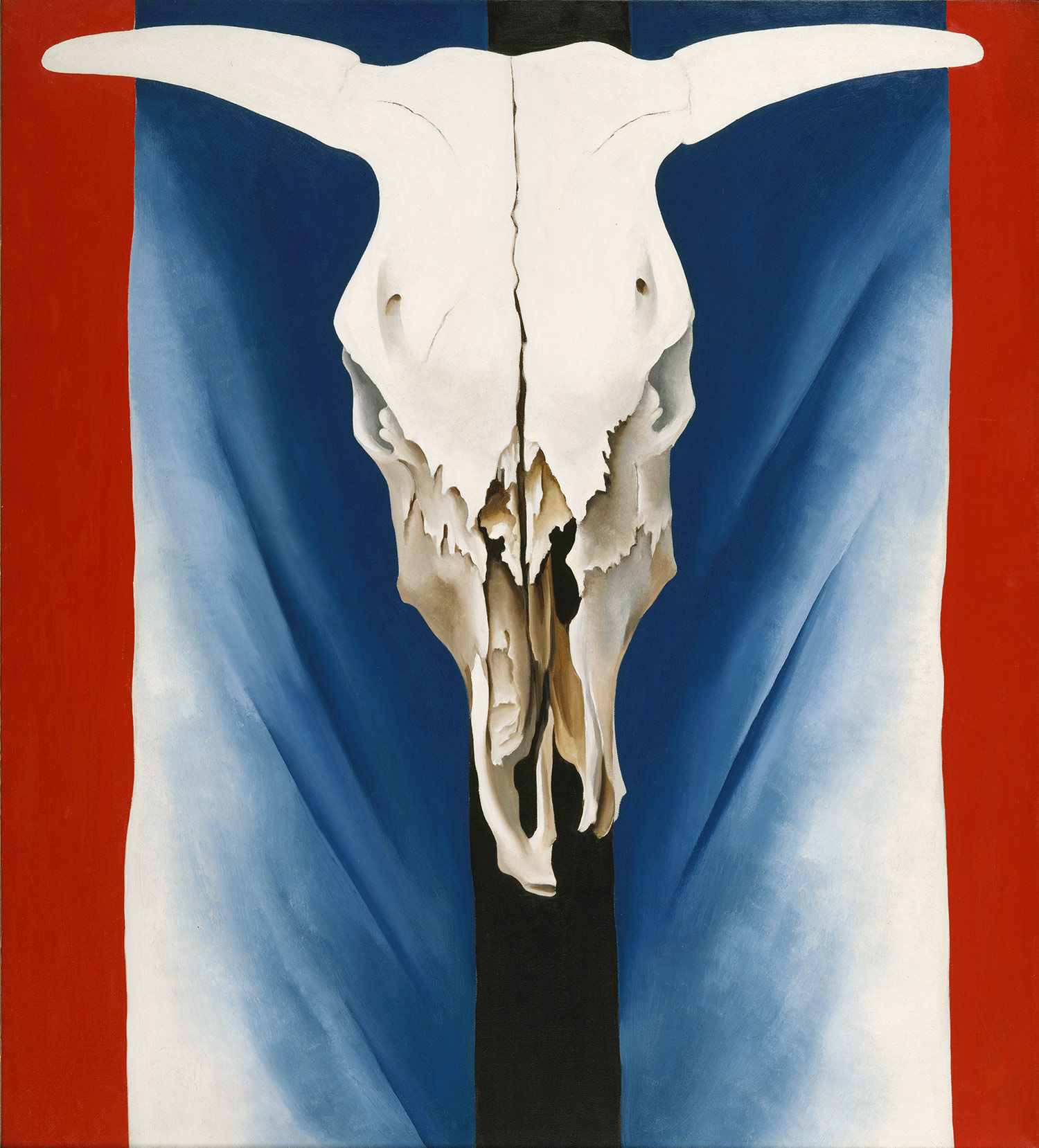
By the way, the museums are once again in sync with one another in this regard. The sexual subtext of the Vermeer exhibit has obvious parallels. Wassily Kandinsky's work went through an exploration of abstraction very similar to that of O'Keeffe at various points in her career. Perhaps I'm being unconsciously indoctrinated, myself. Her depictions of skulls (none of which are in this show) can't help but remind me of Sylvie Rosenthal, and some of her later work very much reminded me of Daniel Zeller's:
Black Place I (1944, oil on canvas)

In any case, I had the added challenge of setting aside my feelings about O'Keeffe's stigma in order to appreciate her work as fully as it deserves. I think I was fairly successful, despite my company in the galleries. I'd seen many of these pieces before, of course, but there's nothing like a full retrospective to clarify what an artist truly accomplished. As usual, the Whitney has done a fantastic job.

The first couple of galleries are devoted to her early studies in watercolor, where you can see how she was beginning to experiment with abstraction and develop the visual elements that would recur time and again throughout her career. Although extremely illustrative, I wasn't as impressed with the watercolors and early oils, so I'd like to begin a little further along.

Dark Abstraction (1924, oil on canvas). The docent kind of joked about the titles O'Keeffe gave her paintings, which said so very little about what the work was. This is a great example.
--This and following three images courtesy SoHo Art.
I'll have to say that I like these darker works far better than the lighter, pastel ones. They just feel so much more legitimate to me. There is always an element of Beauty in all works of art, even those that might be considered ugly. Ugly works of art in their own way question our perceptions and concepts of Beauty, by rejecting it. Ironically, I feel as if I trust the intentions of artworks more if they aren't trying to be "pretty." I also heard it said recently that, once it was commandeered and widely disseminated by industrial production around the beginning of the twentieth century, Beauty became no longer the province of Art.

That's the problem I think I have with her use of color: it's too pretty. In a way, I feel that it isn't challenging me as the viewer and feels cheap and too easy. For instance, I think it'd be fairly easy to see the problems with an evaluation of the historical significance of someone like Robert Mapplethorpe based solely on his floral still-lifes, considering how very shocking and disturbing his other work was. That's not to say Dark Abstraction is ugly in the slightest, quite the contrary. But with these works, she feels more like a real artist to me. Maybe that's pretentious of me.

Corn Dark (1924, oil on composition board)
I also consider her abstract work infinitely more interesting than her representational pieces. Perhaps that's another reason her work often felt little-old-ladylike to me and why I found this show so fantastic. When she got into the skulls and the imagery of the American West, there was the element of something dark--macabre I think is a little too strong a word--to balance out her style. With the flowers, rendered very realistically, it becomes a bit too prissy for me. Not that I can't find beauty in nature, of course, but that's exactly the point. To merely recreate that beauty on the canvas, it's little more than a pale copy. With her more abstract pieces, her artistry becomes tantamount. Here it's the work of art that's beautiful, in and of itself, not the subject being represented. Certainly her artistry comes through in all her different styles. But with the representational work, it's too muddled and obscured by the subject. With her abstract work, the painterly affects she achieved with line and color become much more prominent, and I think it makes the work in this show far more historically poignant.

Red and Pink (1925, oil on canvas)
This was one of the more interesting pieces on view. It's somewhat small, and it's actually one of a series of illustrations for a fabric manufacturer's advertising campaign. O'Keeffe here wasn't painting flowers, but a sheet of fabric with a floral pattern on it.

Pink Tulip (1925, oil on canvas)
This is exactly what I mean. The overwhelming pinkness and the frilly contours of the flower are just a bit too much for me to handle. I can't help but fear it's sexist of me to say such a thing, or at least bordering on it. But perhaps my embarrassing reaction to this painting is precisely the point. The art world was completely overrun by a whole lot of men, none of whom would have or could have painted this painting in a million years. It required a woman's voice for this type of imagery to come into existence. And while she was without question innovative in many ways that later (male) artists would emulate, she was also distinctive in ways they couldn't. She was going down a road where they couldn't follow.

Line and Curve (1927, oil on canvas)
--Image courtesy Happy Shadows.
Another one from this period, Abstraction White (1927, oil on canvas), was unfortunately impossible to find. I can imagine few more obvious precursors to Minimalism than these pieces, and this is nearly forty years earlier. I also really appreciate her work in black and white, because it offers an opportunity to ignore color for the moment and better discern what she was doing with line and field.

Abstraction Blue (1927, oil on canvas)
--Image courtesy Museum of Modern Art.
It's the way lines emerge, converge, diverge, and disappear again. Lines are always appearing out of fields, gradually changing their color or intensity, and threatening to dissolve back into complex fields of color. For O'Keeffe, lines don't just demarcate fields, they become part of the essence, the very body of the fields.

Jack-in-the-Pulpit--No. 3, No. IV, No. 5, and No. VI (all 1930, oil on canvas)
This was really one of the best things about this show. It's a series of paintings of one type of flower, a Jack-in-the-Pulpit (hence the titles), which shows with incredible clarity the process the artist went through in abstracting her subjects.
--Photo courtesy William Tanneberger.
With one simple series, it's as if she's training the viewer's eye to see in a very specific and peculiar way. Seldom has this been possible with any other artist outside of a retrospective of their work, after the fact. These were executed inside a single year.

Green Grey Abstraction (1931, oil on canvas)
--Image courtesy Art in Transit.
She and Stieglitz spent a lot of time apart because she loved to travel and he refused to leave New York City. Upon her return from one retreat, she discovered Stieglitz was having an affair. It devastated her. This dark, somber work is actually a portrait of Stieglitz. The fascinating thing this show illuminates, by focusing on her abstract work, is that she did virtually none of it for this entire decade. Abstraction was very hard on O'Keeffe; it took a lot out of her. It required her to bring to the surface and make manifest something very deep and personal inside her. Representational works were an escape, and in her depression, she found solace in them.

After this period, she began to realize that she could once again start to explore some of the principles of abstraction, but remain true to her interest in landscape and the natural world. This was the period that gave rise to works like Black Place I, above. They are representational, but frame the real world in an abstract manner. From there she continued in this direction, becoming more and more primary. Eventually, by the 1950s, she gets to a place that the Minimalists of a decade later should've been ashamed to not have acknowledged more vocally.

My Last Door (1954, oil on canvas)
--Image courtesy The Art Browser.
Black Door with Red (1954, oil on canvas)
--Image courtesy Antiques and the Arts.
They actually depicted her house and yard. These pieces so obviously prefigure the work of artists in the 1960s, it's quite astonishing. Not long after this, she started going blind. The docent pointed out that there could be no fate more cruel for a painter than this. Beethoven allegedly contemplated suicide. When her eyesight began to fade in the 1970s, she returned to simple watercolors which were easier for her eyes to handle. She lived another ten years, and in 1986, we lost one of the most important artists of the twentieth century.

You have until January 17th to catch the Whitney's show. I must highly recommend it, whether you're a little old lady or not.


[EDIT: To all the porn-seekers who arrived here looking for Georgia's boobs, I hope you learned something.]


©2009, Ryan Witte

Monday, September 28, 2009

Surgical Precision

Another of the artists found at the Amory Show whose work truly impressed me was Daniel Zeller. I'm very glad to have interviewed him. His were some of the most thoughtful, in-depth answers I've ever gotten in an interview, and it was quite fun. Here's my conversation with Zeller:


Ryan Witte: You just got married. How was the wedding?

Daniel Zeller: It was great.

RW: Glad to hear it all went well, and no one got hammered and fell into the cake...or...did they?

DZ: Some folks got a little hammered, but no major disasters--and we had cupcakes instead of a cake, so that whole problem was avoided.

RW: Did each cupcake have a tiny bride and groom on it?

DZ: No, but we did have them all arranged on a "tree."

RW: Oh...I didn't understand what you meant at first. That sounds pretty cool, actually. Where did you have it?


Daniel Zeller, Location Management (2007, graphite on paper), most all images can be clicked for larger views.

DZ: We were married at a day camp called The Village at Boulder Ridge in Barkhamsted, Connecticut (they cater events on weekends). It was fun. They have a climbing wall with a zip line and a pond with an inflatable iceberg for climbing on.

RW: ...And Mini-Golf!

DZ: No Mini-Golf, but they did have bocce.

RW: Oh, there's a Mini-Golf picture on the website...


DZ: Huh, I must have been too preoccupied to notice.

RW: I guess all that pesky getting-married business distracted you from the Mini-Golf. How did you two meet?

DZ: Mika [Yokobori] and I actually met at Pierogi.

RW: Are you both artists?

DZ: She is an artist. We do share certain aesthetic sensibilities. You can see some of her work at [her website].

RW: I see you were born in California. Are you now based in Williamsburg, in the vicinity of Pierogi?

DZ: We currently live in Williamsburg--for three years now. Both our apartment and my studio are indeed quite close to Pierogi. Prior to that, I spent thirteen years in DUMBO, in a very affordable live/ work space that rapidly became unaffordable.

RW: Yeah, it seems neighborhoods all over the city are becoming unaffordable, one by one. I really don't get how enough people to fill up the island of Manhattan are either making three million dollars a year or are willing to have five roommates in a closet-sized studio apartment.

DZ: I've wondered about that, as well. Ah, real estate, the perpetual New York conundrum.

RW: Amen. I'd imagine the type of work you do requires very specific and controlled working conditions. Could you describe briefly where and how you typically work on a piece?

DZ: I do prefer a quiet studio (I'm currently subletting a space from a friend, but will soon be looking to move) where I have some control over what I'm hearing. I listen to a lot of NPR and lots of different kinds of music while I'm working.

RW: It's funny, you know I think every single American artist I've interviewed so far has mentioned listening to NPR. It must be one of the job requirements.

DZ: Maybe we're all Liberals, but I think it's more that they seem to cover the broadest range of topics...and getting up to change the station is a pain.

On very large drawings I work on the wall, mostly standing--on milk crates to reach higher--sometimes sitting. For everything else I work sitting at a nice big drafting table that I managed to find used. It's awesome. It's spring-loaded and adjusts with the release of a single lever. I like to work on several pieces concurrently, to be able to switch back and forth between sitting and standing. It can get tedious to be in the same position for too long.

RW: Yes, I'd think that'd be a one-way ticket to debilitating back problems.

DZ: Back, neck, shoulder, eye, hand--not necessarily in that order.

RW: Am I correct that you begin with an ink drawing and the acrylic color goes in toward the end?


Embedded Inquiry (2008, ink and acrylic on paper)
DZ: I start the ink drawings with line work and outlines that will define where color is added, but I tend to work in patches, adding color as I go. Color is still relatively new to me, and I like to see how different ones work against each other as the drawing develops.

RW: Do you have one type of pen or instrument you prefer or do you like to switch it up?

DZ: Although I'm starting to use a brush just a little where there are wider areas to be filled, I work on the ink drawings almost exclusively with rapidograph pens. They are supremely annoying to maintain...

RW: [LOL] I think I still have a set of rapidograph pens around here someplace. I always found them extremely irritating.

DZ: Yes, they can suck, but when they are working, they rule...I've found that they are great for making consistent and fine lines, especially the Rotring brand. Those use an ink cartridge, so unfortunately, the colors are quite limited. For filling, I mostly use the Koh-I-Noor brand. They have a reservoir that can be refilled with any color that I can mix and different nib sizes allowing for more or less flow.


Occupational Hazard (2008, graphite on paper on panel)
RW: While looking at your piece at the Armory Show, Occupational Hazard, with its extremely intense hatchwork, my friend and I were joking that it appears you might have an Obsessive-Compulsive Disorder. Would you care to defend yourself?


Occupational Hazard [detail]

DZ: I have no defense against Obsessive-Compulsive Disorder, though I would probably describe it as Obsessive-Compulsive Order or Syndrome or something.

RW: I like that, "Obsessive-Compulsive Order."


Occupational Hazard [detail]

DZ: I think we all probably have some degree of it, but I don't think mine is too severe. I have always been attracted to imagery that is packed with detail, so the work I make is the work I want to see. I've had to learn some strategies for being able to sit or stand for hours, making repetitive gestures. But without a pre-existing tendency for Obsessive-Compulsiveness, I don't think I'd have even wanted to try.

RW: You may be pleased to know that, after studying your work much more closely yesterday, last night it showed up in one of my dreams.

I think it was most because of this one: Diffusive Cluster (2007, ink and acrylic on paper). I stared at it for a very long time. The colored sections began to appear as flat plateaus, flush with the surface of the paper. The surrounding lines recede away from the viewer as valleys, similar to a topological map. Trying to get my brain to wrap around the three-dimensional forms I think may have done something to my head.

DZ: I'm not sure whether I'm happy or sorry that something I drew showed up in someone else's dream. I dream some of this imagery, as well, and I'm never quite sure what it means.

RW: Don't worry, I thought it was kind of cool, actually. I'm tempted to believe that certain imagery activates something deeper, neurologically, in the brain and makes a kind of imprint--much the same way that certain songs or jingles get stuck in one's head more than others.

DZ: Someone once told me that ninety percent (or most, anyway) of brain activity happens below the conscious level, and I tend to believe it. It would make sense that studying any complex system or image would put that ninety percent to work. We'd be unaware that we were still thinking about it. I think that we evolved to be able to navigate within a very complex three-dimensional environment, and our brains are wired to retain a lot of this information. It's only fairly recently--in terms of evolutionary time--that we've been making and referring to two-dimensional representations of our world, and very recently since we've had the kinds of imagery that we can create today, through modern technology. We can translate it, and even mostly understand it, but who knows how it is affecting our subconscious?

RW: Honestly, I think you hit the nail right on the head. The three-dimensional world that the human brain is set up to interpret is external to us and "real," at least in a physical, non-philosophical sense. But two-dimensional representations of three-dimensional worlds, as we interpret them, exist only inside our brains. It would make sense that they would get stuck there a little more easily, since that's where they're "born," in a way.

Do you find that after a certain point in the process of creating a piece, the structures in it get fused in your brain, or is it more of a sort of Zen experience, more mechanical?

DZ: I'm pretty sure that many of the structures that I work with are fused in my brain. A large part of the fun of making drawings, for me, is in trying to figure out where they are going as I'm working. The process of physically putting marks on paper is so extremely slow compared to the brain's ability to envision all the possible futures that could manifest on the page. I think it does end up being a Zen-like experience, perhaps in a similar way that driving long distances can be: one has to be very focussed, but at the same time, parts of the brain are liberated to roam and explore. It's being in the moment and out of it at the same time.


Arbitrary Flow (2007, ink and acrylic on paper)
RW: I suspect one possible reason your work does this is because it has the most incredible formal logic to it. Is it a sort of alternative visual language, or a biological process, a way to give a strict order to the personal chaos of expressionism?

DZ: It probably is a kind of alternative visual language.

RW: What got you interested in this method?

DZ: As I started to explain (above), I've always been attracted to certain kinds of imagery, the more complex and detailed, the better. There is so much of it now, covering a huge range from the microscopic to the gigantic. It's almost too much. So I suppose I'm looking for ways to tie it all together and, at the same time, for ways to shred it apart. I don't know if that makes any sense.

RW: I think it does.


Transfer Locus (2004, graphite on paper)
DZ: Take just one source, for example, probably my favorite: satellite imagery. These views encompass so much. They are dense with information, with overlapping and interacting systems of geology, biology, and human artifacts.

RW: I'm with you one hundred percent on this. I've spent hours on Google Maps in satellite view, following the routes of major rivers, examining geological formations, exploring distant part of the globe. It's mesmerizing, really.


Orbital Clusteration (2007, ink and acrylic on paper)

DZ: Yeah, Google Earth is better than video games, and I had to give those up or I'd never have time to do anything. They have Google Ocean or something now. I haven't seen it yet, but I guess it lets you explore undersea topography.

Yet, in many ways, they only reveal a tiny fraction of what is there. They can only allude to what is underneath and to what lies outside the frame. There is a clarity and ambiguity at the same time. I think it is this dichotomy that attracts me--as well as the idea of scale: a satellite-mounted camera is nothing more than a big microscope looking at a pebble in space. Where do we fit into this continuum of scale, now that we have the ability to see so far in either direction?

RW: I'll take that to be a rhetorical question...


Linear Transversion (2007, ink and acrylic on paper)

DZ: Actually, I was hoping you could answer that...

RW: [LOL] Ummm...

DZ: I sometimes feel a little like a drowning rat. There's so much interesting stuff to look at, it's hard to know what to grab onto. I will never be able to better illuminate the kind of imagery that's already out there, because it is already out there, in all of its full and detailed splendor. So I borrow the pieces that I find interesting and splice them together in ways that lead, hopefully, to somewhere unknown. The journey, itself, becomes the focus.


Synthesized Abatement (2008, graphite on paper)
RW: Using line, color, and composition, can an artist manipulate in some predictable way the paths the viewer's eye will travel around through a work of art?

DZ: Artists (and others) have been attempting to manipulate viewers' eyes for a long time now. I think there are certain tools and methods for doing this, although it's ultimately up to each viewer, and everyone brings their own sensibility and history to what they see.


Synthesized Abatement [detail]
RW: The reason I ask this is being aware of how I tend to visually absorb works of art. Some of your pieces almost look like you could take a traditionally representational painting, say, from the Renaissance, lay your work over top of it, and yours would map out a diagram of the painting's compositional elements and patterns of eye movement. But perhaps I'm just projecting, as you say, my own sensibility and history onto it.

DZ: I think that we have all been bombarded with so much imagery by the time we become adults--and there is probably a finite range of "devices" used to manipulate our navigation through the frame--so these patterns have become embedded in us. It's likely that, as I work, I'm channeling something I've stored away subconsciously.

For my own work, I suppose a goal is the keep the viewer's eyes traveling around the image, and when they come to an edge, having something that will cause them to circle around and come back into the frame. As with any image, that may represent a section of something larger. I am intrigued by what is outside the frame, and how one can infer that information using what is inside the frame.

Deregulated Engagement (2007, ink and acrylic on paper)
RW: So there's a very deliberate tension between the self-referential quality of the objects in the frame and the fact that the patterns can extend outside of it, potentially to infinity.


Multiple Dispersion (2007, ink and acrylic on paper)
DZ: I would agree with that, although it's a little different when I'm working on a floating piece (where an isolated form "floats" on the page, surrounded by blank space). While these often refer to multiple systems or objects (sometimes recognizable, sometimes not), I think of them almost as specimens, cut off from some broader context. It's kind of strange in that the viewer not only has to interpret what is there, but also has to infer or even invent a context for it. We are used to seeing maps and photographs that fill the frame, so we understand that whatever is at the edge continues beyond it. But yes, in all cases, infinity is good.

RW: You might find it interesting that one of the major film theorists (I'm fairly certain it was Siegfried Kracauer) extended this idea to narratives. Since film originates in photography, which, as you said, captures a small section of the real world that continues beyond the frame, he said the classical tragedy formula--where the main character dies at the end of the story--is inappropriate for film. Film narratives, he claimed, should be presented as short segments of a larger timeline that continues on after the film ends.

DZ: That makes sense, and he's probably right. But it assumes the narrative ends when the character dies. I would suppose that it would have to continue, whether we like it or not. There are lots of folks affected by the death, and let's not forget about all the worms and microbes for whom he/ she becomes lunch.

RW: Don't think the ancient Greeks ever covered that one...


Implemented Cohesion (2007, ink and acrylic on paper)

A lot of your work seems to allude to the idea of humankind's false belief in its ability to master our environment. It's as if you're performing cosmetic surgery on both a microscopic, viral scale and a grand, geological scale at the same time. It's particularly poignant when, with an effortless wave of her hand, Mother Nature can lay waste to vast areas of Indonesia with a Tsunami or unleash a Swine Flu epidemic. Do you have unusually strong views about the relationship between humans and the planet we inhabit?

Seasonal Overlay (2007, graphite on paper)

DZ: This may be a kind of central question, and one that probably comes closest to the toughest question, which can be summed up: why do I do this? I do indeed have strong views about our relationship to the planet we inhabit, largely informed by what we can so easily see, now that we have the tools for looking. We are voracious as a species, and things are clearly out of balance, rapidly becoming more so.

There is a pair of satellite images in one of the books I have, Satellite Atlas of the World, that depicts deforestation in Brazil. The first is from 1984, the second from 2001. They show in striking clarity how humans have cleared away so much forest in such a short time, and this is happening all over the world. We are consuming the life on the planet.

I don't consider myself an "environmentalist" (though I am surely in that category), because that label completely misses the point. Semantics seem to matter here, because the environment is not something that is "out there." We are the environment, and the environment is us; how we treat it is simply how we treat ourselves. I'm not worried about the planet--it's just a rock--though I'm fairly concerned about the thin layer or skin on the surface of it and the atmosphere above, because it is us, and it is being transformed in ways that likely will not benefit us. That said, I'm just as guilty as any other modern, "civilized" person in my poor treatment of said skin...and thus, of myself.

We are indeed at the mercy of forces we cannot control. At the same time, we are, intentionally or not, changing the dynamics through our actions. Maybe it will all be for the best in the long run, but somehow I don't think it will be that great for humans. I think I remember a George Carlin bit where he said (to paraphrase), "people evolved on earth because the earth wanted plastic."

I'm on board with a great deal of what Carlin says. But I think it's somewhat dangerous encouraging people to dive off the endangered species bandwagon. So many of them are endangered directly as a result of humans' irresponsible behavior.

We are designed by nature to seek gratification. So I think it's just a flaw in nature that we are, at the moment, smart enough to be able to manipulate our surroundings but not smart enough, collectively, to be able to control ourselves, despite obvious evidence that we are on an unsustainable path.

Which brings me back to that nagging question: why do these drawings? I can't really answer the question. The work often feels like a futile, misdirected effort. In the face of such clear evidence of what is happening to our collective skin, and our collective ability to ignore this clear evidence, maybe I'm just looking for another way to see things.


Transitional Schematic (2007, ink and acrylic on paper)
RW: Do human cities behave like gigantic organisms?


Quantified Separation (2007, ink and acrylic on paper)
DZ: Human cities are gigantic organisms, with highways, train tracks, and shipping lanes as conduits or circulatory systems that bring nutrients in from the outside and some of the waste back out. They are connected to and a part of all the other organisms that inhabit our thin surface later. In some ways, they are extremely efficient and economical and yet can be seen as a symptom of imbalance. They cannot sustain themselves without constant input from outside resources. But there are lots of interesting things going on within them, so it could be that the balance might even out eventually. It's hard to know the ecological value of the culture that cities produce.


Sectional Regression (2007, ink and acrylic on paper)
RW: I suppose it's possible that our cities are enormous biological machines that devour resources and convert them into art, culture, different types of communication, and a whole lot of garbage.

DZ: Certainly, but machines can be controlled externally (at least, they are designed to be). Cities are colonies, composed of individuals, each of whom makes countless choices at any given moment. How can one even contemplate any kind of control over such mayhem? Even trying to nudge in a given direction becomes a monumental undertaking. And I think we agree that the waste products of these machines, or colonies, or whatever we call them, are becoming increasingly problematic. Our little world is a closed system, after all.

RW: Absolutely agreed.

So, in what direction do you see your work going in the next few years?

DZ: I have no idea where the work will go next. The thing that keeps me interested is not knowing. I have many ideas for new things to introduce to the mix, but they're too numerous to list, and I don't know which ones I'll actually use. I like the process of slow evolution in the drawings. The work kind of regenerates itself in ways that I can't predict. At the moment, I still get satisfaction from working this way, from the slow, methodical accumulation of marks on paper, but some day it may just drive me nuts.

RW: [LOL] Well, I certainly hope that doesn't happen any time soon!

DZ: I think I'll be okay for a while.

Thanks.

RW: Thanks to you, Dan, for a great conversation.

DZ: You're welcome. It was a pleasure.


Daniel Zeller is represented in New York by Pierogi and in Los Angeles by the Daniel Weinberg Gallery.

©2009, Ryan Witte