For some reason, I'm finding this fascinating. The Zone Improvement Plan "ZIP" codes to expedite postal shipment on addresses in the United States was first proposed in 1944 by postal worker Robert Moon. It was put into voluntary effect in 1963, and became mandatory in 1967.
The 10000 ZIP codes begin in the heart of New York City at 10001, and presumably spiral more or less outward from there.
The 20000 ZIP codes begin in the heart of Washington, DC (though, oddly, not at the White House or the Capital Building).
The 30000s in Atlanta, Georgia, though starting at 30002; there is no 30001.
That all makes pretty logical sense, but here's where it gets interesting.
The 40000s begin in Louisville, Kentucky at 40003.
The 50000s in Des Moines, Iowa.
The 60000s in Chicago.
The 70000s in New Orleans.
The 80000s in Denver, Colorado at 80002.
And the 90000s start in Los Angeles.
The lowest numerical ZIP code is 00501, but that's for an Internal Revenue Service facility located there. Adjuntas, Puerto Rico is also quite low at 00601, but since Puerto Rico is an unincorporated territory of the United States, this was likely a wild card like the IRS location.
Following the logic above, the 00000 ZIP codes should probably be considered to begin in Springfield, Massachusetts--strangely, not Boston--at 01001.
Ryan Witte
Showing posts with label 1960s. Show all posts
Showing posts with label 1960s. Show all posts
Wednesday, May 10, 2017


Wednesday, October 31, 2012
Pheonix from the Flame
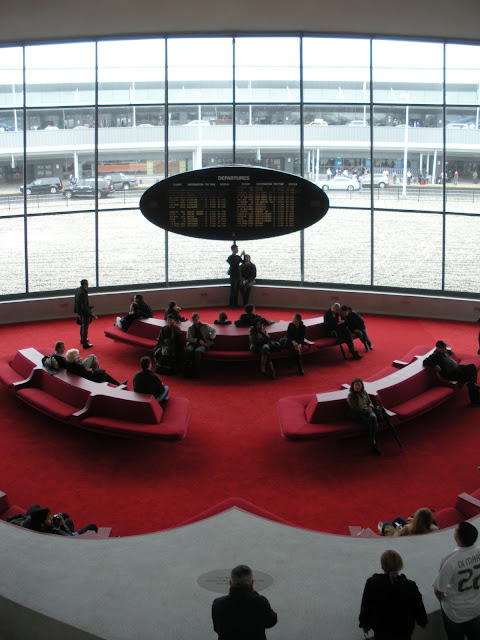
In celebration of Halloween today, I'd like to make an addendum to my series on JFK Airport and talk about my very first time seeing the interior of Eero Saarinen's TWA Flight Center. I've honestly lost count of how many times I'd been out there and couldn't get inside it. On various trips I didn't realize it'd been closed or had heard it had reopened and it hadn't. In fact, on this trip out, I thought I had heard the restorations had been completed, but they haven't this time, either. Presumably I'll have to go out yet again when it has been completely finished and reopened. What they meant, I suppose, is that the restoration of the main central lobby space is done, which it is. It's not open yet, but the doors were unlocked for Open House New York a few weekends ago.
 I did look through music from 1962 in preparation for this visit, but I
didn't have the time to rip all those songs into my computer. Instead I just
loaded up Latin-esque
by Juan Carlos Esquivel onto my iPod. It seemed fitting. There was one
song that came out in late August, 1962 that I've always found somewhat
irritating, but it's just too perfect
to not mention it in this post. Apologies for the "Pickroll" if anyone
feels the same. Amusingly, it may actually be the first song in history
to include the sound of a bong hit.
I did look through music from 1962 in preparation for this visit, but I
didn't have the time to rip all those songs into my computer. Instead I just
loaded up Latin-esque
by Juan Carlos Esquivel onto my iPod. It seemed fitting. There was one
song that came out in late August, 1962 that I've always found somewhat
irritating, but it's just too perfect
to not mention it in this post. Apologies for the "Pickroll" if anyone
feels the same. Amusingly, it may actually be the first song in history
to include the sound of a bong hit.


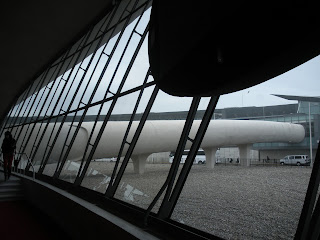 I had seen innumerable photographs, seen floor plans and drawings, studied the model extremely carefully. Nothing came as a huge surprise. On top of that, although it may have been extremely complicated to construct, it's rather simple in form, in the ways that would matter. It's almost perfectly symmetrical. So one nice coincidence is that I'm able to quote one of my top ten movies of all time, Stanley Kubrick's The Shining (1980) on Halloween: "...it was as though I'd been here before. I mean, we all have moments of deja vu, but this was ridiculous. It was almost as though I knew what was going to be around every corner. Ooooo!" It was still magical to finally be inside what I consider to be one of the most incredible works of architecture of the entire twentieth century.


 It is starting to look really beautiful, too. Already it looks noticeably better than the last time I walked around the outside of it. It sounds as if they're going to try to restore much of it back to the period when it was in its heyday as a monument to air travel, from around 1962 to 1969. So all the restaurants and cafes should look extremely groovy. They're also going to retain all reminders that this was once a TWA building. In other words, all the TWA signage will not be replaced by signs for jetBlue. They have a long way to go, but as Saarinen himself said about it being a "beautiful ruin," even in its decrepit state, barely any imagination is required at all to see how fabulously Space Age a work of architecture this is. Evidently the ticket counter wing is going to be converted into a hotel. If they do that right, staying the night there could make it totally worth having your flight cancelled.


 Happy Halloween fellow architecture lovers!

All text and photos 2012, Ryan Witte.


All text and photos 2012, Ryan Witte.
Thursday, May 31, 2012
Extraordinarily Ordinary
(NYIAS)
The next thing to talk about was in the booth for Chevrolet to accompany the release of their new Impala. It was a sky-blue, convertible 1966 Impala Super Sport in seemingly perfect mint condition that was actually much more interesting than the new one. I'd like to say right off the bat that many of the interesting facts herein are courtesy of my friend over at Ate Up with Motor. A huge nod of thanks to him and his vast automotive knowledge.
 It's fortunate that I have such a good excuse to talk about the Impala, considering that I so recently examined Levittown, because the Impala was sort of like the 1960s automobile equivalent to a Levittown house. There was nothing at all exceptional or innovative about it, in fact, its appeal was that it was utterly ordinary. Adding to this is Chevy's choice of a model from 1966 to display at the show. The Super Sport options package was first offered on the Impala in 1961. In 1964, it became the top-of-the-line model, but in 1966 it was surpassed in prestige by the Caprice, which had become its own series. All the standard cars in Chevy's line-up, including Impala and Caprice, shared most of the same basic innards. The differences were in power, styling, and options. There was nothing particularly new about the '66; it was mostly a cosmetic upgrade of the '65. The moral of the story, by 1966 the Super Sport was even less exceptional for a Chevy than previous Impalas had been.
 It was most popular with exactly the same demographic who a decade earlier would have gravitated toward Levittown and communities like it. It was a preferred car for mostly middle-income buyers who wanted a relatively good quality car, easy to service and maintain, but nothing too flashy or outrageous. It's the same demographic that today buys the Toyota Camry and Honda Accord. But while the Camry enjoyed 3% of the market as the best selling car in the United States in 2008, Impala in the 1960s commanded 15% of the market. Out of ten of your car-owning friends, at least one if not two of them would have had an Impala.
It's a fairly mammoth car, over 312 inches long (792cm) and almost 80 inches wide (203cm). Perhaps one of the more interesting things about the engineering of the Impalas from '65 onward was their flexible frame. At the points where the frame curved inward for the wheels at front and rear, the frame was designed to flex to absorb impacts from the road. The body was then mounted onto the frame with no metal-to-metal connections. Instead, rubber pads separated the frame from the body in up to fourteen places, depending on the model. The body was welded together and gusseted extremely rigidly and cross-braced, especially at the front end. The idea was that the body would feel extremely firm while all the vibrations and shuddering from the engine and road were handled by the flexible frame.
 My friend from Ate Up... shared with me one of the critical reactions to Impala at the time which I thought was rather funny. Evidently, the resonant frequency of its coil spring suspension was such that the car would start hopping at certain speeds when driving over the seams of a concrete highway. I'm amused by this in part because I can't remember the last time I was on a highway paved with concrete. Having driven around many parts of the country, I remember the familiar rhythm of those seams in the road slabs. But they use asphalt almost exclusively in the New York area. Asphalt is cheaper and much faster to install on highways that, around here, serve enormous amounts of traffic almost continuously. Potholes in asphalt can also be more quickly and easily spot-repaired rather than having to replace entire sections of road at a time as with concrete slabs.
 In its design, the Impala is anything but a remarkable car. Evidently that was sort of the whole point; above all, it was a safe choice. To put the design of the car under discussion here in some perspective, 1966 was the same year that Ferrari unleashed on Turin this masterpiece by Pininfarina. Nonetheless, in retrospect, there are some nice things about the old Impalas that could have inspired their new one with fantastic results. I think Chevy would have been wise to take a similar approach as they did to the Camaro--and as Dodge did to the Challenger--and look back to the older models for inspiration. For a few things, the broad, muscular grille, forward angled front end, or the side detailing that streaks straight from the front all the way to the back end (most pronounced on the 1964), could have been extrapolated quite wonderfully on a car for 2012.
 Instead, Chevy seems to have recreated the past glory of the Impala in spirit rather than style. Their new offering is about as bland today as the '66 may have seemed when it appeared on the market. I might be tempted to wonder whether it's more difficult for the huge corporate manufacturers to reconcile good design with other concerns like marketing and economics if it weren't for the fact that I've seen comparably large manufacturers overcome these conflicts quite adeptly.
All text and embedded images ©2012, Ryan Witte.
The next thing to talk about was in the booth for Chevrolet to accompany the release of their new Impala. It was a sky-blue, convertible 1966 Impala Super Sport in seemingly perfect mint condition that was actually much more interesting than the new one. I'd like to say right off the bat that many of the interesting facts herein are courtesy of my friend over at Ate Up with Motor. A huge nod of thanks to him and his vast automotive knowledge.


It's a fairly mammoth car, over 312 inches long (792cm) and almost 80 inches wide (203cm). Perhaps one of the more interesting things about the engineering of the Impalas from '65 onward was their flexible frame. At the points where the frame curved inward for the wheels at front and rear, the frame was designed to flex to absorb impacts from the road. The body was then mounted onto the frame with no metal-to-metal connections. Instead, rubber pads separated the frame from the body in up to fourteen places, depending on the model. The body was welded together and gusseted extremely rigidly and cross-braced, especially at the front end. The idea was that the body would feel extremely firm while all the vibrations and shuddering from the engine and road were handled by the flexible frame.


 | |
| The 427 Turbo Jet was newly available on Impala in '66, and was the biggest engine option. |
All text and embedded images ©2012, Ryan Witte.
Subscribe to:
Posts (Atom)