Showing posts with label film. Show all posts

Monday, November 29, 2010

We Couldn't Get Much Higher

The final, inescapable fact remains that architecture is now breaking scale, and style, everywhere. (In his secret heart there is hardly an architect who doesn't want to do so.) The objective historian realizes that the twentieth century is in transition to a remarkable new technology and a formidable new environment, before we have learned how to handle the old one. Who's afraid of big bad buildings? Everyone, because there are so many things about gigantism that we just don't know. The gamble of triumph on this scale--and ultimately it is a gamble--demands an extraordinary payoff. The Trade Center towers could be the start of a new skyscraper age or the biggest tombstones in the world.
--Ada Louise Huxtable, May 26th, 1966

There have been quite a few lines that made me almost gasp and think "Holy @#!+ can this person ever compose a sentence." But the end of that paragraph I'm pretty sure made my jaw drop open. So profound, so prophetic, and with such a deep understanding of what it means to create architecture and the inherent implications of what we build. And I think most appropriate considering where I was headed on the train.

This was what I'd just finished reading when I arrived to see the premiere sponsored in part by DOCOMOMO (who, by the way, have a newly revamped website which looks great) of what turned out to be a gorgeous documentary about Louis Sullivan, titled for him with the subheading The Struggle for American Architecture. It's a wonderful film directed by Mark Richard Smith, and the icing on the cake was that the premiere was held at the showroom for the greatest American furniture manufacturer of the twentieth century: Knoll. There's almost a kind of electric buzz about being in the Knoll showroom, almost as if you're in the vortex of a much bigger storm of creativity and design history.

I was very surprised to hear that no one has ever made a documentary about this man. Actually, there was just one, called Tall: The American Skyscraper and Louis Sullivan from 2006 which concentrated on only one aspect of his career. But really? That's it? There's at least sixteen or so about Sullivan's protégé, Frank Lloyd Wright. For crying out loud, Sullivan pretty much invented the skyscraper, put Chicago on the map as an architectural wonderland, and coined one of the most famous lines in all of architecture: "form (ever) follows function." He's probably the architect most integral to the transition into the twentieth century.

Photo courtesy Photosfan.
The film is brilliantly framed. It starts with the Chicago fire of 1871. It was an obvious choice, but it works so well, both narratively and thematically, because it makes the city, itself, a blank sheet of vellum. The photographs of what remained after the fire are incredible. It was a virtual wasteland, with only a wall still standing here and there. They actually remind me a bit of the shots of European cities immediately after World War II. But Chicago's infrastructure--namely the train lines and the stockyards--was left unscathed, which meant the city could be rebuilt. And was it ever. It was during this boom, needless to say a great time and place to be in any way involved with the building industry, that Sullivan arrived in Chicago and decided it was right where he needed to be.

It was a bit of a bumpy start, because a recession hit that slowed down new construction a bit. Sullivan took this opportunity to go to Paris to study at the École des Beaux-Arts, which he found insufferably boring. While making a side trip to Rome, he discovered Michelangelo's ceiling of the Sistine Chapel, which had a profound influence on him. When he returned to Chicago, he teamed up with Dankmar Adler, who was a fantastic engineer and acoustician, but nowhere near as talented a stylist as Sullivan, making them the perfect team.

It was well known that, if you wanted a great theater, you hired Dankmar Adler. Ferdinand Peck did just that for the design of the Chicago Auditorium. The exterior was uncharacteristically bland for Sullivan, inspired by the adjacent Marshall Field Warehouse (1885) by H. H. Richardson. But it was the largest building of its kind ever constructed at the time.
Image courtesy Chuckman's Photos.

Photo courtesy Sampleboard Online.
The interior of the opera house, on the other hand, was an absolute symphony of ornament and decoration, color and luxurious materials, which Smith's cameras captured with the most loving admiration to the sound of a Richard Wagner swell. The film makes a point to note that, because of the intimate collaboration between the two partners, everything was seamlessly integrated into the interior's style, down to the ventilation grilles and the lighting, which was the frighteningly-new electric technology. It was a gargantuan job, self-inflicted by Sullivan, who wanted to design all the ornament from scratch to cover every inch of the place. A young Frank Lloyd Wright, hearing that Sullivan was swamped, sent over some sample drawings asking if they needed another draftsman. Quite wisely, Sullivan hired him. The Auditorium catapulted the team of Adler & Sullivan to fame. They also made their new home in offices in the building's tower.

His next big breakthrough was a result of his attitude toward buildings, that they should look like what they are. Sullivan was dismayed by the handling of height. The technologies making it possible--namely steel frame construction and the elevator--were too recent, and architects were not sure yet how to deal with it. These early tall buildings were typically in any number of different architectural styles stolen from Western Europe and stretched vertically. His response in 1891 was "every inch a proud and soaring thing," the Wainwright Building in St. Louis, Missouri.
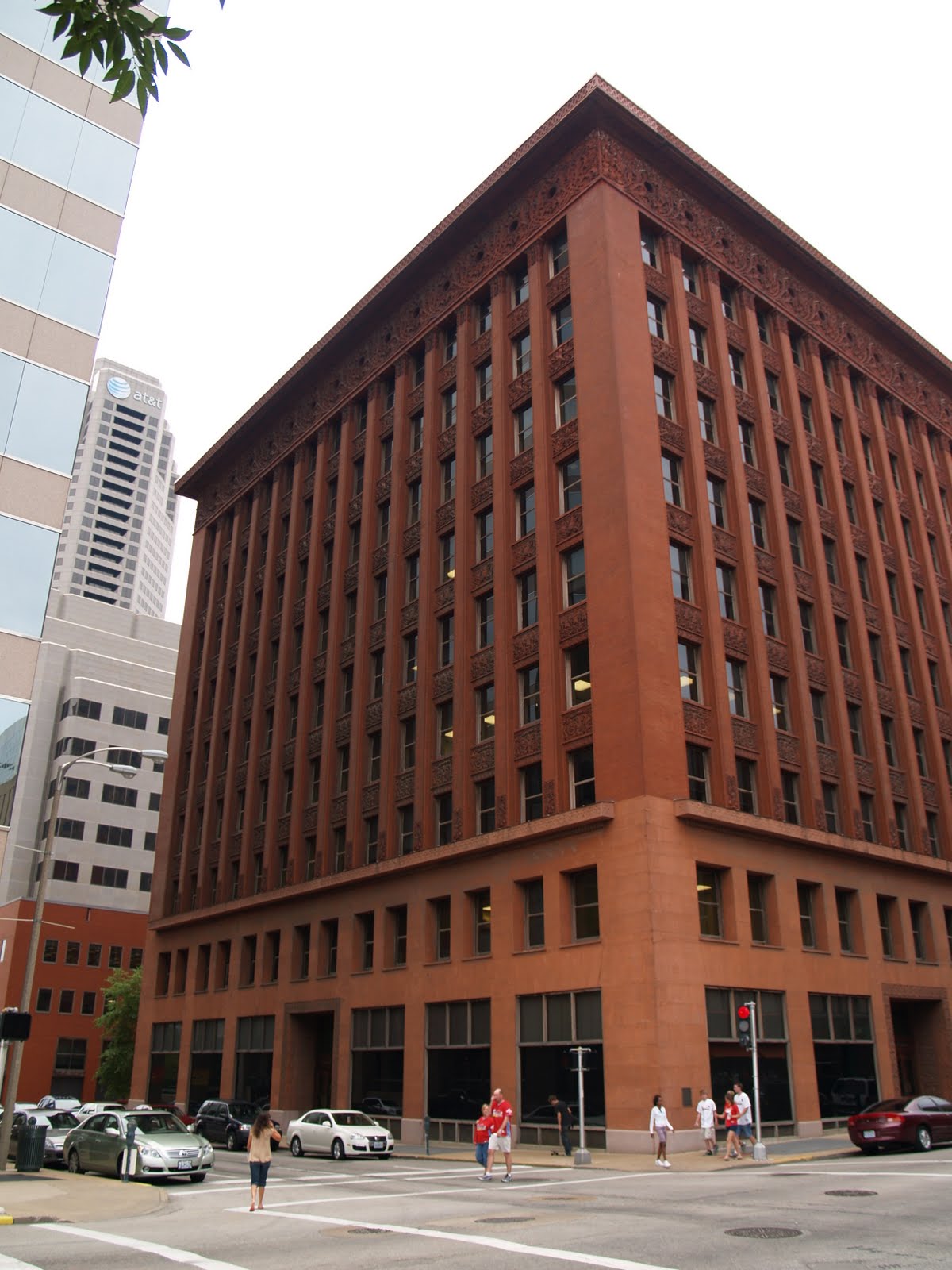
Photo courtesy Brandon.
Because Sullivan thought the main problem was that tall buildings didn't realize what they were, he strongly emphasized the Wainwright's height. His model was the classical column, with base, shaft, and pediment. If you look at the building at a sharp enough angle, you can very much see the fluted column in it. Five years later he did something very similar with the Guaranty Building in Buffalo, New York. Guaranty, however, was an explosion of ornament in terracotta that adeptly masked the necessity of terracotta to be installed in tiles.
Photo courtesy Cuda swiata.

Photo courtesy SFSU.
The end frame for the story appears in 1893: The Chicago World's Fair. The gleaming white architecture of the fair by Daniel Burnham (with Frederick Law Olmstead) was strictly Beaux-Arts (though built, characteristic of our Drive-Thru Fast-Food culture, like a stage set).

Sullivan had rejected all this contrived pomp for being decidedly European. He felt American architecture deserved its own idiom, rather than simply deriving forms from another time and another continent. As the title of the documentary suggests, he was looking for a truly American architectural vocabulary. The country, however, was too young, too fragile in the wake of the Civil War. So while European visitors to the fair were fascinated by Sullivan's unique and colorful Transportation Building, American visitors were much more turned on by the pretense of legitimacy neoclassicism could bestow upon the United States. Sullivan said it set back American architecture by forty years.

From that point on, classicism was it. Every substantial commission purchased a big, white marble Beaux-Arts temple. Nobody wanted Sullivan's eccentric, unfamiliar brand of Americana. His last great large building would be the Carson, Pirie, Scott department store in Chicago.

Photo courtesy iReference.
Quite amusingly, outside of this store is where one can purchase a demon-possessed Good Guy™ doll from a homeless man.

Finished in 1899, this building is easily twenty-five years ahead of its time and about as modern as any building could have been in the nineteenth century. Additionally, his nature-inspired ornamentation was the perfect complement to what was beginning to be understood as the market driving force behind the art of the fashions sold inside the store, namely the changing of the seasons.

Photo courtesy Exoterika.


Sullivan died penniless and broken in 1924. Despite the fact that he'd built one of the most beautiful tombs in the world--for Carrie Eliza Getty--his friends could only scrape together enough money to buy him a sad, forgettable headstone. His last work wasn't even a building, but merely the façade of a tiny little music store. That a man of such unbelievable talent should meet such a tragic end is shameful and disheartening.

The sort of happy post-script onto the story, though, is a flurry of incredible creativity and exquisite work he did for a bunch of small banks in mid-western farm communities. He built eight of them, from 1908 to 1919, in Minnesota, Indiana, Wisconsin, two in Ohio, and three in Iowa. In my opinion, it's some of the best work he ever did.
Photo courtesy Primitive Screwheads.

His use of ornament had reached a level of sophistication that could be matched only by a true genius, like Michelangelo himself, isolated to brief moments of explosion and intricacy, while tempered by expanses of serenity and restraint.


The modest scale and proportions presented a welcoming, down-to-earth stance to the farming communities and very much appealed to them, quite contrary to the overblown elitism of the common neoclassical approach to bank architecture. Furthermore, his use of natural, organic ornament here spoke to the lives of townspeople who earned their living from the land. The banks became beloved. They also ended up in small towns where little ever changes. So in one last, small victory, while much of Sullivan's work was heedlessly demolished, the banks all remain standing as jewels on the countryside.

One of the great things about them is that he'd begun "signing" his buildings. Right underneath the bank's sign, it would say "Louis Sullivan Architect." It sort of reminds me of how Fellini started to put his name into the actual titles of his films: Fellini Satyricon, Fellini's Roma. But entirely justified because Sullivan's work was so distinctive and at the same time, in a way, quite modest.

After the screening, there was a short talk by the director and a Q&A session. He said he'd never made a film before, which made this project a bit difficult to get produced, and makes it even more impressive as a debut effort. I asked Smith if, while shooting the film, there'd been any one building that really grabbed him, that really took his breath away. He said the Guaranty in Buffalo. He lamented the fact that, due to issues with the current owners, Prudential, it was just not possible to get inside it. But he did manage to get some stunning photography of the exterior with the help of a window-washing platform. A couple other questions and we all headed over to finish off the wine they'd so nicely supplied.

I'd said hello to Kathleen, John, and Leslie from DOCOMOMO when I arrived. I'd met them all at their Kips Bay Towers event for Open House New York, which will be the subject of a later post. But afterward I got the chance to chat with John Arbuckle, who I was impressed to discover works for Gwathmey Siegel. He was telling me all about Buffalo since it's the location of the building Smith said most grabbed him. He reminded me that Frank Lloyd Wright's Darwin D. Martin House is also there and is now open to the public, and a few other things that all together might make it worth a trip to Buffalo. I think he might have sold me on going at some point.

I also asked Smith if this might be picked up by PBS or a similar network. He said he had spoken to people at PBS, but that they already have their own stable of directors with whom they work almost solely. I think this is very ridiculous and unnecessary. It limits the voice of their programming and means that some very good material (this film, for instance) will never see air time on their stations.

You can purchase a copy of the DVD (also available on Blu-ray), Louis Sullivan: The Struggle for American Architecture, on the website for the film (link at top). I highly recommend seeing it. Personally, I'm looking forward to buying my copy when the expanded edition is released with (perhaps) behind-the-scenes footage and commentaries and whatever else.

©2010, Ryan Witte

Monday, November 8, 2010

Double Features

It seems like every other week, I'm yet again unable to resist the urge to discuss something that treads on the boundaries of what this blog was supposed to be about. The irresistible temptation up until now has been the Performing Arts, until such time as I see what futuristic insanity Rei Kawakubo's mind has birthed lately. Film, most particularly, is about as over-saturated by uneducated opinions as you can get, mostly because pretty much everyone sees them and proclaims to know what they don't like. But this post I think is far enough out in left field (or perhaps I should say the left side of the Cricket pitch) that I'm just going to go ahead and do it. And I do have a degree in Film Production, after all, so I suppose I should be allowed.

I've been trying to see a lot of Bollywood movies lately.

Asoka (2002), Satosh Sivan Cinematographer
It always baffled me how films from India, an industry that produces more films than even Los Angeles, are practically impossible to see here with any normal kind of consistency. Until the advent of Netflix, that is, bless that cult, but I really meant in the theaters. Certainly it takes getting used to some of the cultural differences. More than the way characters behave--I'd have to be an idiot (at best) to claim that causes me any consternation--I mean the way that physical action, visual signals, and character behaviors affect cinematic meaning. At the same time, these films are positively normal by the standards of a typical American audience compared to the alien things Fellini was doing mid-career, let alone the work of someone like Alejandro Jodorowsky.

And they love those musical numbers. But you'd be hard-pressed to find any American over thirty who hasn't seen at least one movie musical in his or her lifetime, especially if you include Disney. For everyone under forty, I fail to see all that much difference with sitting around watching MTV for a couple hours.


This intimate relationship between popular music and film is a bit troublesome. It means that Pop music is restricted to being compatible with a film context, which is dangerous, especially in clubs. The most innovative club music hasn't been narrative for about twenty years, except for the preferences of silly drunken sorority girls, who are not widely known for their progressive taste in music. It does, though, raise the standards quite considerably for film soundtracks to be club-worthy, an obligation not understood here since probably Footloose, and not fully realized since Grease, or questionably Xanadu. Much of it here is  radio-ready, and put to great use, but it's usually in the Ballad category.

We have the stars of course. John Williams is a brilliant master. Ennio Morricone is an absolute genius. Jerry Goldsmith and Nino Rota generated revolutions.  Giorgio Moroder did it all. But none of them could hold a candle today to Wolfgang Gartner, Saeed Younan, or even Danny Tenaglia on a dance floor (to choose three of my favorites out of many choices).

Well, I think I have a theory. Perhaps if an Indian reader feels I'm getting it all wrong, they'd be generous enough to discuss it. It's actually a combination of different elements creating a problematic result. The language barrier is one part of it, and I'd like to argue than it's actually more of one than it might be with a Romance language, and also that it's more of a problem than, say, Japanese, when combined with other factors.

I get the impression that India's audiences weren't raised as much on the zero-attention-span television media that we did, necessitating the rapid-fire audio-visual bombardment we get with most of our films now. On the other hand, I also get the impression that living in a city like Mumbai is like that, in reality, all the time. So many people, so many vehicles, so many smells, so many colors, so much bustle, so much activity. One might think their cinema would be ponderously slow just to offer a retreat, but they move fast. It's not quite an Oliver Stone pace (and he comes back into the discussion later), but the plot points hit hard and fast.

This is where the language becomes a problem. The pace is fast, and it's a narrative bombardment, as well as cultural. In other words, take for an example the first act of Terminator 3--which, in my humble opinion, is one of the greatest feats of destructive, pyrotechnic, computer-generated action ever put on film. Sci-Fi nerds may compare it to T2 as disparagingly as you wish. Its physical action is overwhelming, but in only a very visceral way. There's not much you have to absorb intellectually, and for the most part, it relies very little on language, much like the popularity enjoyed by some of the Asian offerings, both Gojira and Kung-Fu (the preponderance of dubbing notwithstanding). It's interesting also to note that the pacing of, say, Yasujirô Ozu is extremely leisurely.

It's pretty much understood that Americans love movies because they can't be bothered to ever pick up a book. Subtitles are always going to be a hindrance because no one here wants to read. I'm not quite as cynical as that makes me sound, but you know what I'm saying. To be as fair as I'll care to be, it has to do with the reasons why people go to the movies in the first place, namely for escape.

There's something else here, as well, that I'd like to coin a term to describe if no one already has: Hindglish. My eyes know very well how to handle normal subtitles. In a Chinese film, where I understand none of the spoken dialogue but can focus more on raw intonation, subtitles are a breeze. But I have found it a bit distracting that much of the dialogue in Indian film is quite familiar (English) and much of it so foreign to me (Hindi), but all contained in a single sentence, bouncing back and forth.

The sum of all this--cultural differences, the fast narrative pacing, and the disorientation caused by the dialogue/subtitle dilemma--is that it is a lot of information to absorb. That brings me to the next factor: these movies are LONG. Make no mistake, I have many, many times sat through the entirety of Lord of the Rings installments. I become engrossed. I don't need to pause the DVD fifty times. A friend from India explained that mass audiences there (he very amusingly called them "the mob") wouldn't pay to see a movie if it weren't three hours long, that they'd feel cheated paying the same price for a movie of shorter duration.

I said most Americans can't sit still for much more than an hour at a time, especially without checking their Blackberries a couple of times. I also pointed out the size of an extra-large soda at our neighborhood cineplex. I almost puked just looking at this mammoth plastic vessel. I swear the extra-large is literally a half-gallon of soda. If I drank that much Coke in an hour and a half, quite seriously I'd need to be taken to the hospital. So no way is anyone going to be able to last three hours without going to the toilet. He did point out that they have rather long intermissions, gratefully.

I really lament the fact that our longer films these days don't have intermissions. It seemed like such a civilized inclusion to the experience. I understand that theaters want to pack as many showings into their business day as they possibly can. I also can't help but wonder if the loss of that percentage of ticket sales per day wouldn't be offset by the inevitability of some audience members purchasing another $11.99 barrel of popcorn or $7.95 slab of milk chocolate on their way to or from the restroom.

I'm also not surprised that the Bollywood Dramas are as long as they are. Speaking of Oliver Stone, I was recently
inspired by the similarly intense and brilliant Rajneeti to watch JFK again, a movie I proudly own. Stone's movie is rapid-fire with not only narrative information, but also complex historical references, and it's a relatively long film. But I'm really not surprised by a lengthy Drama anymore. What got me was that the Bollywood Comedies are just as long.

I really thought about it, and in the entire history of American cinema, I could think of only one true Comedy that far surpassed the two-hour mark, It's a Mad, Mad, Mad, Mad World. And for the record, I also believe that is the single most epic Comedy in the history of American film. I say that not because it is so very good or so very funny (or lengthy). There have been plenty of movies that were funnier (although it is soil-yourself hilarious). I say that because on the one hand, its plot is so ingeniously, uniquely simplistic that the greatest comedic insanity could effortlessly be attached to it. On the other, it symbolized a complete 180-degree shift in the nature of comedy as a genre and a vocation, from the old Vaudevillian Guard of both live theater and the Golden Age of Hollywood to the figures who would make their names and whose work would be shaped by the brand new medium of television.

I'm going to see more of these works and perhaps my impressions will change. I've found them entirely entertaining. I think it may be that it's too much for typical American audiences to handle, in intensity and duration. In New York, maybe we have a chance. We've always loved foreign films here. Our city is intense, its pace speedy compared to Los Angeles, the suburb-without-an-urb that has molded our continent's understanding of cinematic expression in its own image. Still, we have no city here that runs at the pace of Mexico City, Tokyo, Hong Kong, or I suspect Mumbai. I'm just happy I live relatively close to Jackson Heights so I might have a chance to enjoy them.

©2010, Ryan Witte

Tuesday, July 15, 2008

This Is Not a Museum Exhibition

This past Friday, I went over to see the Salvador Dali exhibit Painting and Film at the Museum of Modern Art.  It's really incredible, and I highly recommend it.

Right outside the show they were playing a Buster Keaton film, a scene from One Week.  

I just adore Buster Keaton.

I'd seen both L'Age d'or and Un chien Andalou while in film school, so I didn't spend too much time on those.  There were a couple of other incredible things to be seen, however.

I went chronologically backwards, and first saw Dali's video work, Chaos and Creation (1960).  

I'd never seen this one, but it was pretty funny because he was totally making fun of Piet Mondrian.  He has a sort of pig pen with various compartments, which viewed from above looks like a Mondrian painting.  Then there's pigs and mud and a girl covered with food or some kind of goop writhing around in it.  This one was getting those comical kind of matter-of-fact observations from the crowd ("It looks like one of those hamster balls."  "There's soapy water in it.") that indicate they have no idea what the hell they're watching.

Next was Warhol's screen test of him.  It's sort of an unfortunate viewing experience in a crowded gallery, and a shame that they don't appear to be showing that one in their movie theater (which, by the way, is a fantastic place to see films).  I'd seen a bunch of Warhol's films at a festival at Film Forum many years ago, when I worked there.  I had a number of religious experiences during that festival, but Warhol's screen tests were really mind-blowing.  For the first few minutes, you think "okay, the person's just sitting there, doing nothing.  So what?"  But as you sink deeper into the experience of it, you start to notice the most unbelievably subtle things about the person's facial expressions.  The very, very slightest raise of an eyebrow, twitch of the lip, or series of blinks begins to take on the most profound significance.  You realize in the end, you've seen much deeper into this person's soul, their real persona, precisely because they're sitting there doing nothing at all.  I think my favorite of those I saw was the one of Henry Geldzahler, former curator of the Metropolitan Museum of Art.  

He starts playing with his eyebrows halfway through and is just a goofy character.

Then there's Dali's Impressions de la Haute Mongolie from 1975, where he looks every bit the "guru in drag" that Lennon did.  He also appears like he'd have been a hilarious person to be around.

They're also showing his dream sequence for Hitchcock's Spellbound.  

I feel like I have the vaguest recollection of knowing that the sequence was actually by Dali, himself, but it's been a very long time since I'd seen it.  Hitchcock said he was bored with the hazy, out-of-focus way dream sequences were often done, because he felt that dreams were in fact quite sharp and vivid, much like Dali's paintings.  The best thing about this, in my opinion, is they have the actual studio backdrop from the film shoot there, a giant black and white canvas hanging in the gallery.

It was very cool to see The Persistence of Memory in person.  

I can't recall if I've ever seen it, although it's definitely possible.  It's very small, there was a huge crowd of people around it, about eight deep, so there was really no way I was going to be able to interact with that painting.  To make matters worse, there was this couple standing directly in front of it, pretending to know ALL ABOUT what the whole thing means, pointing out all the symbolism and having an oh, so intelligent conversation about it, meanwhile blocking everyone else's view of the piece.

Regardless, there are so many great paintings that for sure I'd never seen, in person or otherwise, that I didn't necessarily need to spend an hour on Persistence.

I think what excited me most, did you know that he had collaborated with Walt Disney?  No, really, it's true!  Dali felt Disney was actually one of the few true Surrealists himself.  A few years after Fantasia, Disney wanted to do another similar film, but perhaps more serious.  So he began working with Dali on a segment for it called Destino in 1940.  

They only completed about 18 seconds of it until the project was abandoned perhaps due to lack of funds.  But then in 2003, a group of Disney animators got together and finished it, based on the original treatment.  It's playing at the show, and it's really quite creepy and beautiful.

Oh, and just to make the whole thing even more Surreal, I bumped into a total blast from my past, John Witherspoon, The Artist Formerly Known as Lahoma Van Zandt.

As a man, though.  Lahoma was the greatest emcee to ever grace the stage of Limelight's Disco2000 (which I told him, a little too enthusiastically), and allegedly his trip from Atlanta to New York with Larry Tee and RuPaul was the basis for To Wong Foo...  I hadn't seen him around in years and years, which is kind of sad because Lahoma was such a hoot.  Maybe she'll do a comeback tour.

©2008, Ryan Witte

Monday, June 16, 2008

Watching the Wheels

To conclude my posts on the BKLYN DESIGNS show, here are a couple new items from one of my favorite companies, Site Specific Design.  They were in my second year's coverage of the show and they're a really nice group of people.

Their series of Childhood Memories pieces are a lot of fun, many of them based on bugs, and I was really impressed by this new one, "Nephila":

I'd seen the newsletter about it, and actually thought it might be a free-standing piece.  At the show I saw that it hangs on the wall, and only the top portion is solid metal tubes.  From the squiggly metal tubes dangle a bunch of power cables that spaghetti around on the floor.  (Yes, I know "spaghetti" isn't a verb).  All of them have plugs or sockets at the end of them, but of course only one of them is live.

This table is a brand new piece they debuted at the show:

Click that.  They found these ENORMOUS antique drill press wheels by accident on ebay and were inspired by them to make this table.  The designer, I believe it was Rui Docouto, was explaining to me that they originally thought to strip the paint off them, but then realized that they had this really amazing rough golden hue to them, so they left them as is.  The great thing about this piece is that it has a very rustic, industrial kind of aesthetic to it, but if you look at the wooden tabletop, it's uncommonly thin.  It gives the piece a real sort of delicacy.  I thought it was lovely.  I also hope they're able to find more drill press wheels (or similar) so they can offer more pieces along these lines.

Marketing Director Nahid Rupani also told me about some plans concerning Brooklyn's design community in general that I was very impressed and excited about, but I'm not sure if that's a matter of public record just yet, so I'll leave you in suspense on that one.

Site Specific Design
718-486-6341

Also...

This video of Rem Koolhaas' Maison á Bordeaux is absolutely breathtaking.  Go watch it.

©2008, Ryan Witte